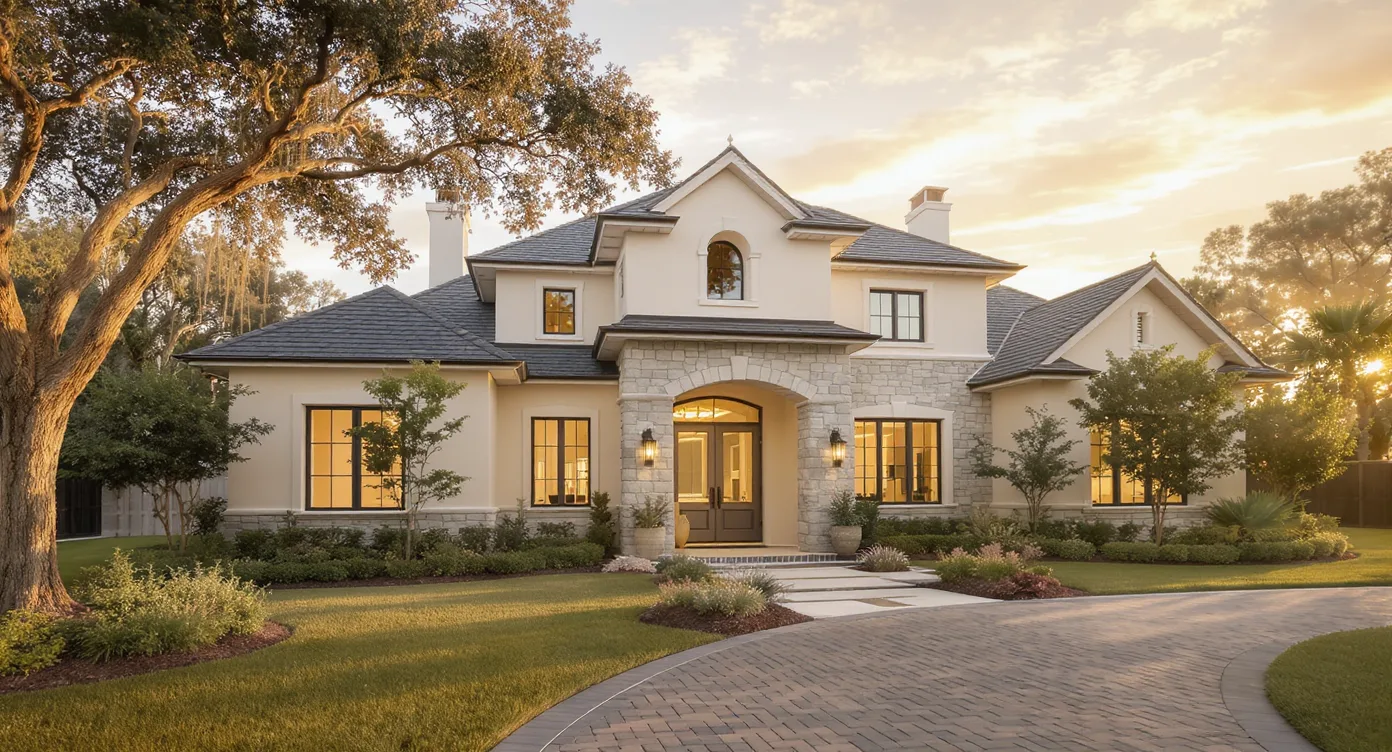
custom home building
How Do I Choose a Custom Home Builder in Greater Tampa Bay?
How to choose a custom home builder in Greater Tampa Bay: verify the license, read the contract, judge finished work, and ask the questions that reveal fit.
Choosing a custom home builder in Greater Tampa Bay comes down to three things you can actually verify before any money changes hands: an active Florida contractor license, a portfolio of finished homes that resemble what you want, and a written contract that spells out scope, allowances, and schedule up front. Everything else (the personality fit, the design ideas, the model-home polish) matters only after those three check out. A custom home is a year or more of your life and one of the largest purchases you'll ever make, so the goal of the selection process isn't to find the cheapest bid. It's to find the team you'll still trust when a hard decision comes up in month eight.
Start With the License and the Record
In Florida, custom homes are built under a Certified or Registered General or Building Contractor license, and you can confirm any builder's standing yourself through the state's Verify a Licensee tool at the Department of Business and Professional Regulation. Search the company name or the qualifying agent, and check that the license is active, unexpired, and free of unresolved discipline. A legitimate builder will hand you the exact name to search without hesitation. Alongside the license, ask how long the company has operated under its current name and ownership. Longevity isn't proof of quality on its own, but a builder who has weathered multiple market cycles and hurricane seasons in the same community has a reputation that's expensive to walk away from.
Judge Finished Work, Not Renderings
Renderings sell a feeling; finished homes reveal a standard. Ask to see completed projects in person or, at minimum, detailed photography of homes the builder actually delivered, not stock imagery or design-competition entries. Look at the parts that are easy to rush: cabinetry reveals, tile transitions, trim miters, how the trades met at corners. Then ask to speak with owners who are a year or two into living in those homes. The useful question isn't "were you happy at handover"; it's "how did the builder handle the thing that went wrong," because on a project this size, something always does.
Understand How the Builder Is Structured
Some builders design and build in-house; others build from plans you bring or from a separate architect's drawings. Neither is automatically better, but the difference changes your experience. With a design-build team, one accountable group carries your project from first concept through final inspection, so a structural or code question gets resolved in the room instead of bouncing between an architect and a contractor for weeks. If you already have an architect you love, a builder comfortable executing another firm's design may suit you better. What you want to avoid is ambiguity about who owns the outcome when design intent and field reality collide.
Questions to Ask Before You Sign
A short, pointed interview tells you more than a thick brochure. Ask:
- How do you handle allowances and selections? You want a written allowance schedule, not surprises when you pick real cabinetry and stone.
- What does your change-order process look like? Every custom project has changes; the healthy sign is a documented, priced process (not a handshake and a bigger final invoice).
- Who is on site day to day, and how will I hear from you? Know your point of contact and the communication rhythm before construction, not after.
- What's your realistic timeline, and what drives it? A builder who explains the assumptions behind the schedule is more trustworthy than one who just quotes a fast number.
Compare the answers across your two or three finalists. Consistency and candor matter more than the single lowest figure. On custom work, the lowest bid usually rises once allowances are reconciled against real selections.
What Local Experience Actually Buys You in Tampa Bay
Greater Tampa Bay is not one market, and a builder's local track record shows in how they handle its differences. South Tampa's waterfront and historic neighborhoods carry flood-zone review and older housing stock; coastal Pinellas sits in the wind-borne-debris region with stricter opening-protection requirements; inland Plant City and Lakeland lots bring their own soil, setback, and estate-lot considerations. Florida also builds to demanding standards under the Florida Building Code, 8th Edition (2023), with its wind-load and mandatory soil termite pre-treatment requirements, and a builder who works here every week handles those permitting and engineering realities without treating them as surprises. Carapezza has built and renovated across these submarkets since 1989, and that regional fluency is exactly what separates a smooth build from a stalled one.
Planning a custom home in Greater Tampa Bay? Call (813) 707-0235 or explore our custom homes work and portfolio, then reach out to start the conversation.
Questions
Frequently Asked Questions
How do I verify a custom home builder is licensed in Florida?+
Look the company or qualifying agent up on the Florida Department of Business and Professional Regulation's Verify a Licensee tool. A custom home should be built under a Certified or Registered General or Building Contractor license that is active and in good standing. If a builder can't or won't give you the exact license name to search, treat that as a warning sign.
What should be in a custom home contract before I sign?+
A complete scope of work, a clear allowance schedule for selections like cabinetry and flooring, a payment schedule tied to construction milestones, a written change-order process, and a realistic timeline with the assumptions behind it. Vague one-page proposals are where most disputes start.
Is a design-build builder better than hiring an architect and contractor separately?+
Design-build puts design and construction under one accountable team, which tends to catch buildability and code issues during design instead of mid-project as change orders. Separate contracts can work well too, but they put the coordination on you. The right answer depends on how much involvement you want.
How many builders should I interview?+
Two or three is usually enough if you've done the homework first. Interview builders whose finished work already resembles what you want rather than collecting a stack of bids and choosing on price alone. The lowest number on a custom project rarely stays the lowest once allowances are reconciled.
How long has Carapezza been building in Tampa Bay?+
Carapezza has been a family-owned builder in the Greater Tampa Bay area since 1989, more than three decades of custom homes, renovations, and design-build work across Hillsborough, Pinellas, Polk, and the surrounding counties.
Related Guides
Our Disciplines
More Guides
Get Started