Commercial Buildouts · Tampa Bay
Restaurant Buildouts
A restaurant is the hardest commercial space to build — and the most unforgiving on schedule. Here's how we take a white-box or an old lease space to a passed health inspection and an open kitchen.
A restaurant buildout is not an office with a kitchen bolted on. It's a commercial kitchen, a grease and fire-suppression system, a health-department inspection, an ADA path of travel, and a dining room that has to feel like somewhere people want to spend an evening — all on a lease where the rent clock started before you served a single plate. As a state-licensed Florida building contractor, Carapezza builds these for Tampa Bay operators the way we build custom homes: tight schedule, real coordination between trades, and finishes that hold up. This is what the work actually involves.
The Scope
What a restaurant buildout actually involves.
Most restaurant spaces come to us in one of two states: a white-box shell from the landlord — bare slab, demising walls, a stubbed utility point — or an old restaurant or retail lease that has to be gutted and re-fit. Either way, the work splits into two very different worlds that have to be built at the same time. The back of house is a regulated industrial kitchen: hoods, gas, grease, drains, refrigeration, and a health code that decides whether you open. The front of house is hospitality design — the bar, the seating, the lighting, the surfaces a guest touches — and it has to feel intentional, not like a remodel that ran out of budget.
The reason restaurants are the toughest commercial buildout is that nearly every trade is on the critical path and they all depend on each other. The hood location drives the make-up air, which drives the rooftop HVAC and the structural work to carry it. The grease line drives the floor drains, which drive the slab cuts, which have to happen before the floor finishes. The electrical service has to be sized for the equipment list before you can frame a wall. Get the sequence wrong and you're jackhammering finished floors to add a drain you forgot — which is exactly the kind of mistake that turns a four-month build into seven. The same coordination discipline shows up in our office buildouts and retail buildouts, but a restaurant stacks more regulated systems into the same square footage than either of them.
Back of House
The commercial kitchen, system by system.
This is the part a residential remodeler or a generic GC underestimates. A commercial kitchen is a coordinated set of life-safety and sanitation systems, each with its own inspection. Here's what we build into it.
Hood & exhaust
Type I exhaust hoods over the cooking line, ducted up through the roof, sized to the equipment beneath them — and balanced against the make-up air so the kitchen doesn't run negative and starve your burners.
Fire suppression
An ANSUL-style wet-chemical system tied into the hood, the gas shutoff, and the building alarm. It's a hard inspection gate — no suppression sign-off, no certificate of occupancy, no opening night.
Grease management
Grease-duct cleanouts, a code-compliant grease interceptor or grease trap sized to your fixtures, and the routing to keep it serviceable. Jurisdictions size and locate these differently, so we confirm yours early.
Walk-ins & refrigeration
Walk-in coolers and freezers set on the right floor detail, with condensate and drainage planned in — plus the dedicated circuits and clearances the equipment schedule calls for.
Floor drains & sloped floors
Trench and floor drains cut into the slab, floors sloped to drain, and a sanitary, sealed, washable floor system that survives a daily hose-down and passes a health inspection.
Plumbing & sinks
Three-compartment warewashing sinks, hand sinks where code requires them, a mop sink, grease-waste lines kept separate from sanitary, and hot-water capacity sized to the kitchen — not to an office.
Code & Inspections
Health department, FBC commercial, and ADA.
A restaurant has to satisfy more than one authority, and they don't all sign off at the same desk. The building department reviews against the Florida Building Code commercial provisions — structure, occupancy, egress, energy, accessibility. The health department(in Florida, the Division of Hotels and Restaurants or the county health unit, depending on the operation) reviews the plan for sanitation: finish schedules, sink counts, food-safe surfaces, grease handling, and the layout of the kitchen itself. The fire marshal reviews suppression, egress, and occupant load. We build the package so each of those reviewers gets what they need the first time — because a re-submittal isn't just paperwork, it's weeks.
ADAis where a lot of restaurant projects quietly go over budget. The accessible route has to run from the parking and entry through the dining room to the restrooms, the restrooms themselves have to meet clearances and fixture requirements, the bar and a portion of seating have to be accessible, and door hardware and thresholds all count. In an older lease space that was never compliant, bringing the path of travel up to current standards can be a real line item — and it's far cheaper to design it in than to discover it at final inspection. We flag it during the walkthrough so it's in the number from day one, the same way we handle accessibility on our commercial buildouts generally.
The Backbone
MEP: power, gas, plumbing, and air.
The mechanical, electrical, and plumbing systems are where a restaurant lives or dies. They're invisible when they're right and catastrophic when they're wrong.
Most commercial kitchens need three-phase powerand a service sized to a full equipment list — ranges, ovens, fryers, walk-ins, dish machines, HVAC. If the landlord's white-box only delivered single-phase or an undersized panel, getting three-phase power to the space can mean a utility upgrade with its own lead time, and that needs to be discovered at scoping, not framing. Gashas to be sized and routed to the cooking line and connected to the hood's fire-suppression shutoff. Plumbing carries the grease-waste, sanitary, and hot-water loads a kitchen demands. And HVAC with make-up airis the one people forget: every cubic foot the hood exhausts has to be replaced, tempered, or the kitchen turns into a hot, negative-pressure box that fights its own equipment and makes the dining room uncomfortable. We coordinate all of it as one system, because that's the only way it actually works.
Why Speed Is Money
The rent clock — and why your schedule is the budget.
Here's the math that defines a restaurant buildout: you start paying rent when you sign, but you don't earn a dollar until you open. Every week of construction is a week of rent against zero revenue, plus carried equipment, insurance, and staff you may already be hiring. A good landlord deal often includes a tenant improvement (TI) allowanceand sometimes a few months of free rent — but that free-rent window is a clock, and if the build runs past it, you start paying full rent on a space that still isn't open. That is the single biggest killer of restaurant runway, and it's almost always a sequencing-and-permitting problem, not a labor problem.
The hood, the suppression, and the health inspection are the schedule
Front of House
Finishes and atmosphere that earn the check average.
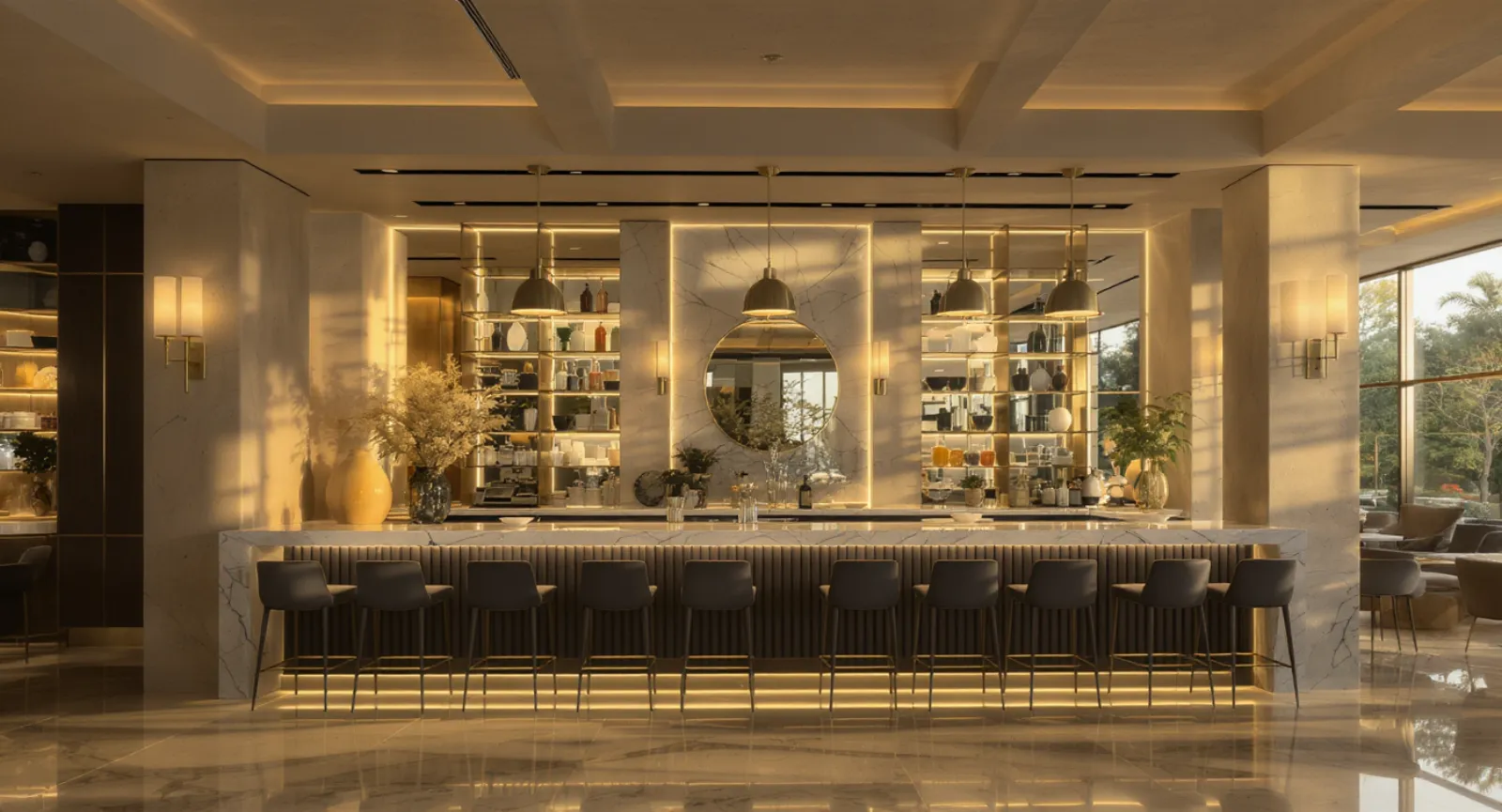
Guests never see the grease interceptor, but they feel the dining room in the first ten seconds. The front of house is where your concept becomes real — the bar build, the banquettes and seating, the lighting that sets the mood without making people squint at a menu, the acoustics that let a full room still feel like a conversation, and the surfaces that take a beating from daily service and still look right a year in. This is the part where building custom homes actually matters: we treat millwork, tile, lighting, and finish carpentry as design, not as a punch list. A restaurant that looks built-to-last reads as a restaurant worth its prices — and the finish quality is what separates a buildout that photographs well on opening night from one that looks tired by its second season.
The Lease
Working inside a lease, a landlord, and a TI allowance.
A restaurant buildout is a tenant-improvement project, which means there's a third party in the room: the landlord. The lease defines what the landlord delivers (the white-box condition), what the TI allowancepays for and how it's drawn, who owns what at the end, and what you're allowed to touch — roof penetrations for the hood, exterior work, structural changes, and signage usually need landlord and sometimes adjacent- tenant sign-off. We're used to building inside those constraints and working shoulder-to-shoulder with property managers, because the alternative — finding out mid-build that you can't put a grease duct through that part of the roof — is the kind of surprise that stops a job cold.
We also help you make the TI allowance work for you. Allowances are typically reimbursed against documented, completed work, so the draw schedule and the lien paperwork have to be clean or the money stalls. Keeping that side organized is part of the job, the same way we coordinate it on office and retail tenant improvements.
Permitting Reality
Grease, impact fees, and the jurisdiction you're in.
Two identical restaurants on opposite sides of a county line can have very different permitting paths. Across Tampa Bay — Hillsborough, Pinellas, Pasco, Polk, and the cities within them — jurisdictions differ on how they size and require grease interceptors, how they handle sewer-capacity and impact feeswhen you change a space's use to food service, how long plan review takes, and whether the utility can deliver the power and sewer capacity your kitchen needs. A space that was an office last year may owe impact fees the day it becomes a restaurant. None of this is a reason to panic — it's a reason to scope it before you sign, so the lease, the budget, and the schedule all reflect the real jurisdiction you're building in rather than a generic assumption.
We scope your space — no flat prices, no generic timelines
How We Build It
From signed lease to passed inspection.
- 01
Walkthrough & scope
We walk the space — white-box or existing — confirm what the landlord delivered, review your equipment list and concept, and identify the power, gas, grease, and ADA realities that drive the budget and schedule.
- 02
Design & equipment lock
We coordinate the kitchen layout, hood and make-up air, MEP, and front-of-house design, and lock the equipment schedule early so long-lead items are ordered and the systems can be sized around them.
- 03
Permitting & approvals
We assemble a plan set that satisfies building, health department, and fire marshal in one pass, confirm the grease and impact-fee requirements for your jurisdiction, and clear any landlord and utility sign-offs.
- 04
Demolition & rough-in
We gut what needs gutting, cut the slab for drains and grease lines, run the three-phase electrical, gas, and plumbing rough-in, and set the structure for rooftop equipment.
- 05
Kitchen & systems
Hood, exhaust, make-up air, fire suppression, walk-ins, refrigeration, sinks, and the sealed, sloped, washable kitchen floor go in and get balanced and tested as a coordinated system.
- 06
Front-of-house finishes
The bar, seating, lighting, millwork, tile, and finish carpentry are built to the concept — the part guests see and feel — while the back of house heads toward inspection.
- 07
Inspections & opening
We carry the project through building, health, and fire inspections to the certificate of occupancy, close out the permits and the TI draw paperwork, and hand you a kitchen ready to open.
Why a builder who treats your opening date like a closing date
A restaurant buildout rewards a contractor who understands that the schedule is the budget and the inspections are the schedule. As a state-licensed Florida building contractor that builds custom homes across Greater Tampa Bay, Carapezza brings the coordination a multi-trade, multi-inspection job demands, the finish quality that makes a dining room feel worth its prices, and a habit of front-loading the things that blow opening dates — the kitchen equipment, the hood and suppression, and the health-department review. We work inside your lease, with your landlord, and against your rent clock, so the space opens when you need it to. Bring us the lease and the concept, and we'll tell you what it really takes to open.
Questions
Restaurant Buildouts in Tampa Bay — FAQ
How long does a restaurant buildout take in Tampa Bay?+
It depends on the condition of the space, the equipment list, the utility situation, and how fast your jurisdiction reviews plans — a clean white-box with a simple concept moves far faster than gutting an old lease space that needs a power upgrade and new grease infrastructure. We don't quote a generic timeline because it wouldn't survive your actual lease. We walk your space, build the scope, confirm the permitting path, and give you a real, staged schedule to open.
What's the difference between a white-box and a second-generation restaurant space?+
A white-box is a bare landlord shell — slab, demising walls, a stubbed utility point — so you build the entire kitchen and dining room from scratch, but with no demolition and no surprises hidden behind old finishes. A second-generation space (a former restaurant) may save you on some infrastructure like grease and hood, but only if those systems are sized and code-compliant for your concept; often they aren't, and you're paying to demo and rebuild. We assess which one you actually have before you bank on the savings.
Do you handle the commercial kitchen — hood, fire suppression, and grease trap?+
Yes. The commercial kitchen is the heart of the project: Type I exhaust hoods sized to the cooking line, make-up air balanced against them, ANSUL-style wet-chemical fire suppression tied into the gas shutoff, grease-duct cleanouts, a code-compliant grease interceptor, walk-in coolers, floor and trench drains, and the three-compartment and hand sinks the health code requires. We coordinate all of it as one system because that's the only way it passes inspection.
Will my restaurant pass the health department inspection?+
That's the whole point of how we build the plan. In Florida, restaurants are reviewed for sanitation by the Division of Hotels and Restaurants or the county health unit depending on the operation — they check finish schedules, sink counts, food-safe surfaces, grease handling, and the kitchen layout itself. We design to those requirements from the start and build the package so the health reviewer gets what they need the first time, rather than discovering a problem at final inspection.
What is a TI (tenant improvement) allowance and how does it work?+
A TI allowance is money the landlord contributes toward building out the space, defined in your lease. It's usually reimbursed against documented, completed work on a draw schedule, so the paperwork and lien releases have to be clean or the money stalls. We help you make the allowance work for you, keep the draw documentation organized, and build inside whatever the lease allows you to touch — roof penetrations, structural changes, and signage often need landlord sign-off.
Does my space need three-phase power?+
Most commercial kitchens do, because the equipment list — ranges, ovens, fryers, walk-ins, dish machines, and HVAC — adds up fast. If the landlord's white-box only delivered single-phase or an undersized panel, getting three-phase power to the space can require a utility upgrade with its own lead time. That's exactly the kind of thing we check at scoping rather than discovering mid-build, because it can move your whole schedule.
Why does make-up air matter so much in a restaurant?+
Your hood exhausts a large volume of air to clear smoke and heat from the cooking line. If that air isn't replaced — that's make-up air — the kitchen runs negative, which starves your burners, pulls conditioned air out of the dining room, makes doors hard to open, and leaves the whole space hot and uncomfortable. We size and balance the make-up air against the hood as one system so the kitchen and the dining room both work the way they should.
Do permitting and impact fees vary across Tampa Bay jurisdictions?+
Yes, significantly. Hillsborough, Pinellas, Pasco, Polk, and the cities within them differ on how they size grease interceptors, how they handle sewer-capacity and impact fees when a space changes use to food service, and how long plan review takes. A former office can owe impact fees the day it becomes a restaurant. We confirm the real requirements for your specific jurisdiction before you sign, so the lease, budget, and schedule reflect reality.
Can you also build out an office or retail space?+
Yes. Restaurant buildouts are the most complex commercial work we do, but the same coordination and finish discipline goes into our office buildouts and retail buildouts. If you're a multi-concept operator or developing a mixed space, we can handle the whole tenant-improvement program, not just the kitchen.
More Commercial Buildouts
Carapezza Custom Homes
Got a lease and a kitchen to build?
The day you sign, the rent clock starts. Let's walk the space, scope the kitchen and the code path, and give you a real schedule to open — before the lease eats your runway.