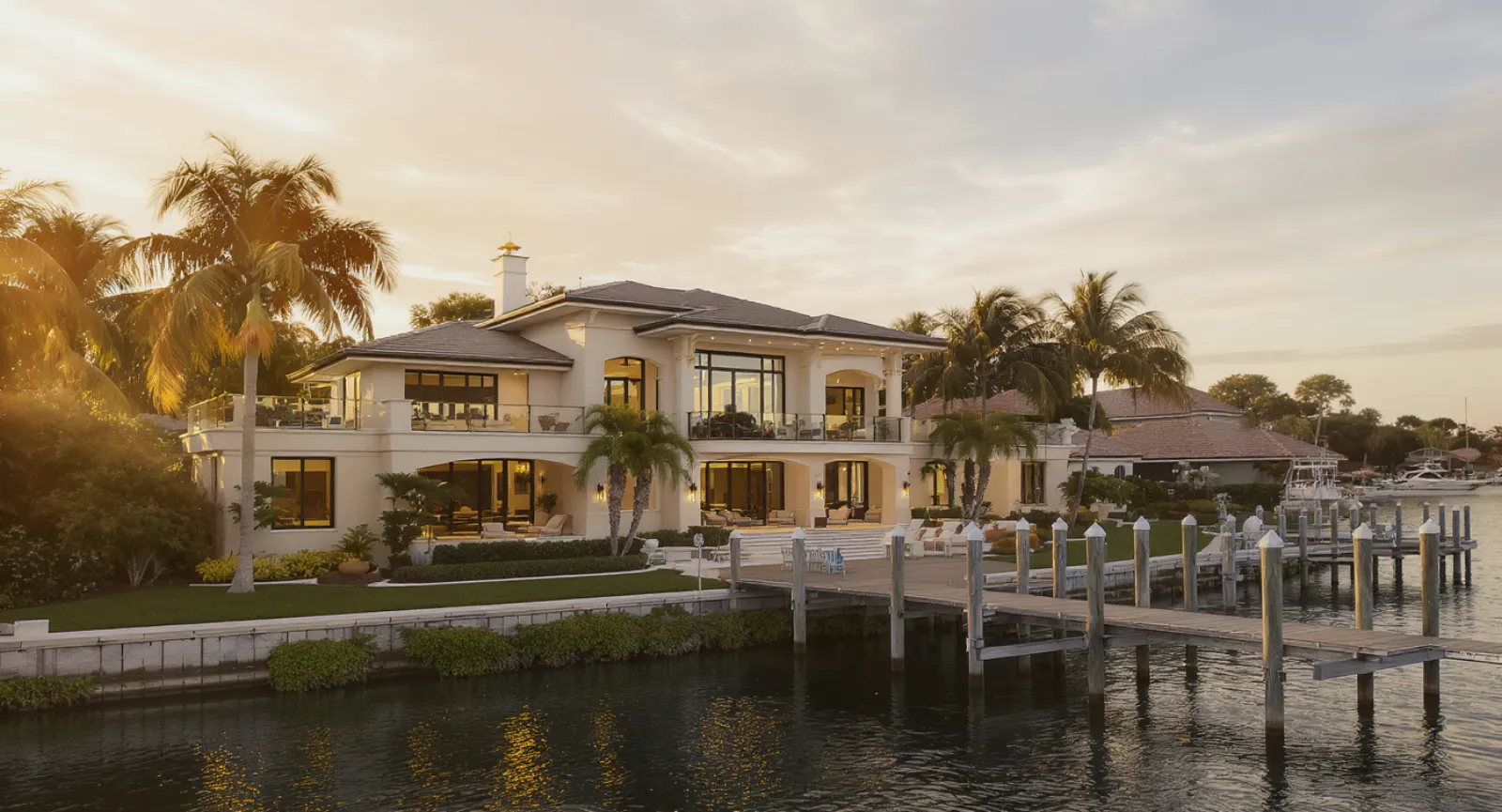
Service Areas · Pinellas County
Custom Home Builder in St. Petersburg
On a low peninsula where 1920s waterfront character meets strict flood code, building well in St. Pete means building smart about elevation, the FEMA 50% rule, and the water. Here's how we approach it.
St. Petersburg is one of the most desirable — and most regulated — places to build a custom home in Tampa Bay. It's a narrow peninsula reaching into the bay and the Gulf, where almost every waterfront and near-water lot sits in a FEMA flood zone, where 1920s historic neighborhoods carry design review, and where Hurricanes Helene and Milton rewrote what a lot of legacy homes are allowed to become. As a licensed Florida general contractor that's been building across Greater Tampa Bay since 1989, Carapezza builds and rebuilds homes here with the flood rules, the codes, and the City's permitting in view from day one — not discovered halfway through.
Why St. Petersburg Is Different
A waterfront city built on a flood-zone peninsula.
St. Pete has the kind of waterfront that draws people from all over the country: direct bay and Gulf access, walkable historic streets, a downtown anchored by the restored Vinoy and the St. Pete Pier, and a 1920s Mediterranean Revival character you can't reproduce from scratch. What makes it remarkable to live in also makes it demanding to build in. The peninsula sits low, the soil is sandy and saltwater-prone, and the flood maps cover most of the lots people actually want.
That tension is what defines the custom-home market here. A large share of the city's best lots carry aging homes — charming, but built decades before today's flood and wind codes. The economics increasingly favor either an elevated new build or a deep, code-compliant rebuild rather than a like-for-like remodel. After Helene and Milton pushed water into thousands of homes in 2024, that shift accelerated. We help homeowners read which side of that line their property falls on before they spend a dollar.
Where We Build
St. Pete neighborhoods we know.
Each pocket of the city has its own lot character, flood reality, and design expectations. A few we work in often:
Snell Isle
Waterfront prestige on Tampa Bay — 1920s Mediterranean, generous lots, direct bay access, and an active teardown-and-rebuild market where elevated new construction is increasingly the play.
Old Northeast
Historic, tree-canopied, and walkable to downtown. Much of it is on the National Register, and the Granada Terrace pocket carries formal design review — character has to be respected, not erased.
Shore Acres
Northeast St. Pete canal and bayfront living, and one of the city's most active rebuild zones after recent flooding — a common path from a flooded legacy home to an elevated 2,500–5,000+ sq ft custom build.
Coffee Pot Bayou
Quiet waterfront access and bay views near Old Northeast, with the same elevation and flood considerations that come with any near-water St. Pete lot.
Venetian Isles & Shore Acres canals
Eastern canal living with bay and Gulf access — among the more attainable waterfront in the city, and a frequent entry point for teardown-rebuild.
Tierra Verde, Bayway Isles & the barrier islands
Deed-restricted, deep-water, and Gulf-front living south and west of downtown, including St. Pete Beach and historic Pass-a-Grille — where coastal high-hazard (VE) rules often govern the build.
Codes & Climate
Flood zones drive almost every decision here.
On a peninsula this low, nearly every waterfront or coastal lot lands in a FEMA flood zone — most often AE, VE, or Shaded X. The zone isn't a formality; it dictates how high the home has to sit and how the ground level can be built.
- AE zonesrequire the lowest floor to be elevated to the base flood elevation plus Pinellas' freeboard, typically built on open pilings or posts with flood-venting at ground level.
- VE zones (coastal high hazard)are stricter still: the home must sit on open pilings or columns with breakaway walls below the flood elevation and no solid foundations — the source of those distinctive elevated silhouettes you see on the barrier islands. Building at the south end of St. Pete Beach? Our Pass-a-Grille custom home guide covers the historic district review and height cap that apply there.
- Shaded Xlots carry no mandatory elevation, though flood insurance is still wise — and zone boundaries get re-mapped, so today's X can become tomorrow's AE.
Wind code matters just as much. Under the Florida Building Code's Wind-Borne Debris requirements, glazed openings near tidal water must be impact-resistant or shuttered, and a meaningful code change on the horizon is expected to push the higher wind envelope across essentially all of St. Pete for new construction. And because the peninsula's soil has poor bearing capacity, an engineer-driven pile foundation with soil testing is routine here — not an upgrade, a baseline.
The FEMA 50% rule — the thing to understand first
Permitting
Who approves your build — and how it flows.
- 01
Confirm jurisdiction & flood zone
We establish whether your lot is City of St. Petersburg or unincorporated Pinellas County, and pin down its FEMA flood zone — AE, VE, or X — because that governs everything downstream.
- 02
Optional preliminary plan review
For complex waterfront or historic lots, an early preliminary review with the City surfaces flood, elevation, and zoning issues before full drawings are committed.
- 03
Engineering & elevation design
A licensed engineer designs the pile foundation and elevation to meet base flood elevation plus freeboard, with soil testing to match the peninsula's bearing capacity.
- 04
Historic review where required
If the lot sits in Granada Terrace or another designated zone, we prepare the Certificate of Appropriateness for exterior design alongside the building package.
- 05
Submit & shepherd the permit
We assemble and submit the package online and work the review to completeness — a well-prepared application typically clears in a few weeks.
- 06
Build, inspect & certify
Through construction we coordinate inspections and, for elevated homes, the elevation certificate that documents finished height for the City and your insurer.
Inside the city limits, your authority is the City of St. Petersburg's Construction Services group, with submissions handled online; unincorporated pockets fall under Pinellas County. A complete, well-prepared package typically moves through review in a matter of a few weeks, and for complex waterfront projects an optional preliminary plan review can surface flood and zoning issues early. Where a lot sits in a designated historic area — Granada Terrace and a handful of one-block zones — exterior changes also need a Certificate of Appropriateness, while much of Old Northeast's National Register status is informational rather than restrictive. We map this out for your specific address up front so nothing stalls the project midstream.
Coastal & Flood-Prone Lots
When the answer is to raise the home.
For flood-prone waterfront neighborhoods — Shore Acres, the Venetian Isles and canal homes, Coffee Pot Bayou, and the barrier-island lots in VE zones — the decision often isn't whether to elevate but how. Some homes are strong candidates to be lifted onto a new, taller foundation. Others, especially those already past the 50% threshold after Helene and Milton, make more sense to rebuild elevated from the ground up. The teardown-and-rebuild economics frequently favor new construction once you weigh the insurance savings that come with a fully code-compliant, elevated home.
That's a substantial enough subject that we wrote a dedicated guide to it — covering the FEMA 50% rule, the Elevate Florida funding program, NFIP Increased Cost of Compliance coverage, and how a lift actually works step by step. If your St. Pete property is flood-damaged or sits in a VE/AE zone, start there.
Read next: Home Elevation & the Elevate Florida program
Why Carapezza in St. Pete
A builder who knows the water, not just the walls.
Plenty of contractors can frame a beautiful house. Building well in St. Petersburg asks for more than that: a builder who reads flood maps before drawing plans, who knows what AE versus VE means for the foundation, who can run the 50% math honestly, and who can carry a project through historic design review when the lot calls for it. We've been doing custom homes, remodels, and storm-damage restoration across Greater Tampa Bay since 1989, and Pinellas' coastal reality is part of how we think, not a complication we discover on site.
Practically, that means we'll tell you the truth early. If a remodel you have in mind would trip the 50% rule and force a full elevation, you'll hear it before you commit — not after demolition. If your lot is a better candidate to rebuild elevated than to lift, we'll show you the comparison. And whatever the path, we manage the engineer, the City's permitting, the pile foundation, and the finished home to a standard you'd expect from a company that builds custom homes for a living.
A note on every figure on this page
Questions
Building in St. Petersburg — FAQ
What is the FEMA 50% rule, and how does it affect my St. Pete remodel?+
If your home is in a flood zone and the cost of a renovation reaches roughly half of the structure's market value (the building, not the land) within a rolling 12-month window, the whole home must be brought up to current flood code — typically elevation, impact glazing, flood venting, and utility relocation. The cost counts labor, materials, permits, engineering, and contractor markup. Several smaller projects can add up to the threshold, so the smartest move is to talk to a builder before any piecemeal renovation. We help you run the math for your specific home and confirm the current threshold with the City or county.
Can I renovate a flood-zone home in St. Petersburg without elevating it?+
Sometimes — it depends on your zone and how much you spend. Staying meaningfully under the substantial-improvement threshold can let you renovate without triggering full flood-code compliance, but the rules differ between AE and VE zones, and the 12-month lookback means timing matters. We map out what you can do at what budget before you start, so you don't accidentally cross the line that forces a full elevation.
What's the difference between AE and VE flood zones for building?+
Both require elevating the home above the base flood elevation, but VE — coastal high hazard, common on the barrier islands — is stricter. VE homes must sit on open pilings or columns with breakaway walls below the flood elevation and no solid foundations, which produces those distinctive elevated coastal silhouettes. AE zones allow open pilings or posts with flood-venting at ground level. Your zone shapes the foundation design and cost, so it's one of the first things we confirm for your lot.
How much does it cost to elevate a house in St. Petersburg?+
It varies widely with the size of the home, the foundation type, the soil, and how far it has to be raised — and program funding can offset much of it for qualifying homes. We don't publish a flat price because it wouldn't hold up. We assess your specific home and give you a real number alongside any funding you may qualify for. Our Home Elevation guide covers the full picture of elevation and the funding behind it.
Are there historic-design rules in Old Northeast and nearby neighborhoods?+
In parts of the area, yes. Granada Terrace and a few designated one-block zones require a Certificate of Appropriateness for exterior changes, while much of Old Northeast's National Register status is informational rather than restrictive. We confirm exactly what applies to your address up front and prepare any required design review alongside the building permit, so historic character is respected without surprises.
Does a teardown-and-rebuild make more sense than remodeling here?+
Often it does, especially after Helene and Milton. Once a flooded legacy home is past the 50% threshold, rebuilding it elevated from the ground up frequently costs less and delivers a better, fully code-compliant home than lifting an aging structure — and a modern elevated home typically carries lower flood-insurance costs. It's an honest case-by-case comparison, and we'll show you both paths for your lot rather than steer you toward the bigger job.
How long does permitting take in St. Petersburg, and who approves it?+
Inside the city, the City of St. Petersburg's Construction Services group reviews building permits, with submissions handled online; unincorporated areas fall under Pinellas County. A complete, well-prepared package generally clears review in a matter of a few weeks, and an optional preliminary plan review can catch flood and zoning issues early on complex waterfront lots. Permit and impact fees vary by project, so we confirm current figures for your build.
Why does building on a St. Pete waterfront lot need special foundation engineering?+
The peninsula is low and the soil is sandy with poor bearing capacity and saltwater intrusion, so an engineer-driven pile foundation with soil testing is routine here rather than an upgrade. Combined with flood-zone elevation requirements and wind-code demands near tidal water, the foundation is one of the most consequential — and most lot-specific — parts of the budget. We bring the engineer in early so the design and the cost are clear before you commit.
Our Services
Get Started
Carapezza Custom Homes
Thinking about building or rebuilding in St. Pete?
Before you commit to a remodel budget or a teardown, let's look at your flood zone, your lot, and the 50% math together. That one conversation saves the most money.