Remodeling & Renovations
Kitchen Remodeling
The kitchen is the one room that touches everything — plumbing, gas, electrical, structure, and how your whole house lives. Here's how a real design-build kitchen remodel comes together in Tampa Bay.
A kitchen remodel is the most rewarding renovation most homeowners ever do — and the one most likely to go sideways when it's run by a crew that only swaps cabinets and countertops. Moving a sink, relocating a range, opening a wall to the living room: each of those crosses into plumbing, gas, electrical, and sometimes structure. As a Florida design-build custom-home builder, Carapezza handles the kitchen the way we'd handle a room in a home we're building from scratch — one team carrying the design, permits, trades, and finish so the result looks and works the way you pictured it.
Beyond Cabinets & Countertops
What a real kitchen remodel actually involves.
On the surface a kitchen is cabinets, counters, and appliances. Underneath, it's the most mechanically dense room in the house. A meaningful remodel almost always touches several trades at once: cabinetry and countertops, yes, but also plumbing for the sink and dishwasher and any pot filler, a gas line if you cook with gas, electrical for new circuits, under-cabinet lighting, and the dedicated runs that modern ranges, ovens, and microwaves demand, plus ventilation, flooring, drywall, and paint to tie it together.
The scope question that drives everything else is simple: are you keeping the layout or changing it? A “pull-and-replace” remodel — new cabinets and counters in the same footprint — is faster, cleaner, and easier to budget. The moment you move the sink, slide the range to a new wall, or take out a wall to open the kitchen to the living room, you've added plumbing reroutes, gas and electrical relocation, possible structural work, and the permits that come with all of it. Both are worth doing. They're just very different projects, and being honest about which one you want is the first real decision.
This is exactly where a builder's perspective earns its keep. We design the kitchen and build it with the same team, so the cabinet layout, the plumbing rough-in, the electrical plan, and the finish schedule are coordinated from day one instead of negotiated between subs who've never met. Fewer surprises behind the walls means fewer change orders in front of them.
Layout & Design
Designing a kitchen that actually works the way you cook.
A beautiful kitchen that's awkward to use is a failed remodel. Before we talk finishes, we map how the space moves — and in Florida, that usually means designing for entertaining as much as for cooking.
The old “work triangle” — sink, range, refrigerator within an easy few steps of each other — still matters, but modern kitchens are better thought of as zones: a prep zone, a cooking zone, a cleanup zone, and a landing zone for groceries and serving. When two cooks share the space, or when the island doubles as the spot everyone gathers, the triangle becomes several overlapping paths, and the job is keeping them from colliding.
The islandis usually the heart of the decision. It can hold the sink or the cooktop, add seating, hide storage and a microwave drawer, and give you the counter space Florida entertaining demands — but only if there's enough clearance around it (roughly 42 to 48 inches of walkway is the comfortable range). Force an island into a kitchen that's too tight and you get a beautiful obstacle. A real pantry— whether a walk-in or a bank of tall pull-outs — is the other quiet hero; it's what keeps the counters clear in the kitchen you actually live in, not just the one in the photos.
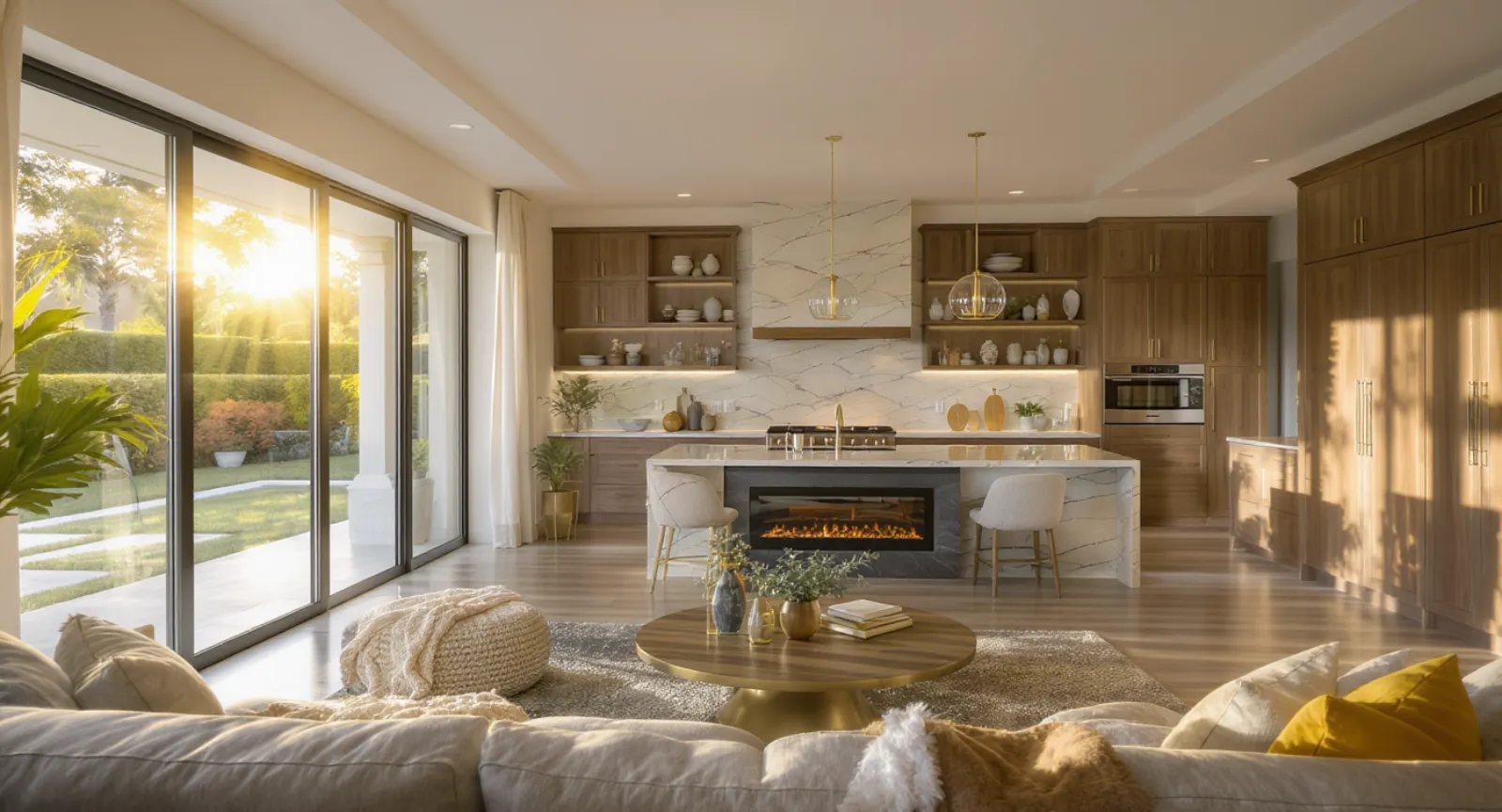
Tampa Bay homes lean hard toward open-conceptlayouts, where the kitchen flows into the great room and out toward the lanai. That's wonderful for entertaining and it's why so many local remodels involve removing a wall. It also changes the brief: when the kitchen is on display from the living room, the cabinetry, the range hood, and the lighting become furniture, and ventilation and noise control matter more because cooking smells and dishwasher hum now travel into the whole living space.
Materials & Finishes
The choices that decide how the kitchen looks — and how it holds up.
Finishes are where a kitchen earns its character, and in our climate they're also where the wrong choice shows up fast. Here's how we think about the big ones.
Cabinetry
The single biggest visual and budget driver. Stock, semi-custom, or fully custom — and in Florida humidity, the box construction and finish quality matter as much as the door style. This is our home turf as a builder.
Countertops
Quartz, granite, quartzite, or porcelain each behave differently with heat, staining, and our hard water. We help you weigh look, maintenance, and durability rather than just picking a slab.
Flooring
Large-format porcelain tile and luxury vinyl are Tampa Bay favorites for good reason — they shrug off humidity, spills, and sliding bar stools far better than solid hardwood near a sink.
Lighting
Layered lighting — recessed, under-cabinet task lighting, and statement pendants over the island — is what makes a kitchen feel finished. It's also new circuits, so it's planned with the electrical, not after.
Ventilation
A properly sized, vented range hood is non-negotiable in a tight, humid, often open-concept Florida home — it pulls heat, grease, and moisture out instead of recirculating them into the great room.
Backsplash & fixtures
Tile, faucets, hardware, and the sink are where personality lands. We coordinate finishes across the room so the metals, tones, and styles read as one designed space.
Because we build and finish custom homes, the kitchen connects naturally to the rest of what we do. If you want furniture-grade, made-to-fit cabinetry rather than boxes ordered from a catalog, that's our custom cabinetry work. If you're after the elevated materials and detailing that make a kitchen feel like part of a custom home, that's the world of luxury finishes. A kitchen remodel is often where homeowners first see that level of craft — and decide they want it elsewhere in the house too.
How It Runs
A design-build kitchen remodel, step by step.
- 01
Design & layout
We walk your kitchen, learn how you cook and gather, and develop a layout — keeping the footprint or changing it — along with cabinetry, finishes, and a realistic budget range for the scope you choose.
- 02
Selections & ordering
Cabinetry, countertops, tile, fixtures, lighting, and appliances are finalized and ordered. We place long-lead items early so the project isn't stalled waiting on a delivery once demolition starts.
- 03
Permitting
If the plan moves plumbing, gas, or electrical — or removes a wall — we assemble the permit package with your county or city and schedule the inspections the work will require.
- 04
Demolition & rough-in
The old kitchen comes out, and plumbing, gas, electrical, and any structural framing are roughed in to the new plan and inspected before anything is closed up.
- 05
Cabinetry & countertops
Cabinets are set and leveled, counters are templated and installed, and the sink, range, and appliances are fit — the point where the new kitchen finally takes shape.
- 06
Finishes & punch-out
Backsplash, flooring, lighting, paint, and hardware go in, final inspections are passed, and we walk the finished kitchen with you to close out every last detail.
A typical kitchen, start to finish, tends to run from several weeks for a clean pull-and-replace to a few months for a full layout change with moved utilities and structural work — and a meaningful chunk of that happens before demolition, in design, ordering, and permitting. Cabinetry and certain countertops carry real lead times, so we order long-lead items early and stage the work so your kitchen isn't torn open while we wait on a delivery. We'll give you a realistic, staged schedule for yourkitchen rather than a number off a chart — the honest range depends on the scope you choose.
Built For Florida
What our climate and code change about a kitchen.
A kitchen in Plant City is not a kitchen in Denver. Humidityis the first reality — it's why we steer homeowners toward stable cabinet construction and finishes, moisture-tolerant flooring, and a vented hood that actually moves air outside. Hard wateris the second; much of the Tampa Bay area runs hard, which spots fixtures and shortens the life of finishes and appliances, so it's worth planning for filtration or a softener loop while the plumbing is already open.
If your kitchen has exterior glazing — a window over the sink, a slider out to the lanai, a pass-through to an outdoor kitchen — that glass falls under Florida's wind-borne-debris requirements in much of our coverage area, which means impact-rated (hurricane) windows and doorsor approved protection. It's an easy detail to overlook in a kitchen plan and a costly one to discover at inspection, so we flag it up front. And because so many Tampa Bay kitchens open straight onto the lanai, designing for indoor-outdoor entertaining — a serving window, durable surfaces, a layout that lets people flow between the island and the pool deck — is one of the most requested things we do here.
Moving plumbing, gas, or electrical means permits — and that's a good thing
Why a custom-home builder for a kitchen
Plenty of companies install kitchens. Fewer can engineer one. The difference shows up in the parts you don't see at the showroom: a cabinet run that's scribed perfectly to an out-of-square wall, a plumbing reroute that lands the island sink exactly where the design wants it, an electrical plan that powers the lighting and the appliances without a maze of visible cords, and a finish level that matches a custom-built home rather than a flip.
As a Florida design-build contractor — family-run since 1989 and based in Plant City — Carapezza carries the whole project under one roof. We design the kitchen, manage every trade, pull the permits, and finish the room ourselves, so there's one team accountable from the first sketch to the final walk-through. If your kitchen is one piece of a bigger plan, it slots naturally into the rest of our remodeling and renovation work — baths, additions, or a whole-home update — with the same hands and the same standard throughout.
Questions
Kitchen Remodeling in Tampa Bay — FAQ
How long does a kitchen remodel take?+
It depends heavily on scope. A pull-and-replace remodel in the same layout can run several weeks, while a full layout change with moved plumbing, gas, electrical, and structural work runs a few months — and a good portion of that is design, ordering, and permitting before demolition even begins. Cabinetry and some countertops carry long lead times, so we order early and stage the work. We give you a realistic, staged schedule for your specific kitchen rather than a generic estimate.
Do I need a permit to remodel my kitchen in Florida?+
A cosmetic refresh — new cabinets and counters in the same spots — may need little or no permitting. But the moment you relocate the sink, range, gas line, or add new electrical circuits, or remove a wall, Florida jurisdictions require permits and inspections for that work. Requirements and timelines vary by county and city, so we confirm exactly what your address needs and pull the permits as part of the project.
What does a kitchen remodel cost?+
There's no honest flat number, because cost tracks scope: cabinetry level, countertop material, whether utilities and walls move, and the finishes you choose can swing a budget dramatically. We work in tiers — from a clean refresh of the existing layout up to a fully reconfigured, custom-finished kitchen — and scope a real number for your kitchen after we've seen the space and your selections. We'd rather give you an accurate range than a guess that won't hold up.
Can you move my sink, stove, or open up the kitchen to the living room?+
Yes — this is exactly where a design-build builder matters. Relocating the sink or range means rerouting plumbing, gas, and electrical; opening a wall to the living room can involve structural framing and a header. We design it, permit it, coordinate the trades, and finish it as one team, so the layout change is engineered properly rather than improvised.
Should I keep my kitchen layout or change it?+
Keeping the layout (a pull-and-replace) is faster, cleaner, and easier to budget, and it's the right call when the existing flow already works. Changing it — moving utilities, adding an island, going open-concept — costs more and takes longer but transforms how the space lives. We'll walk your kitchen and give you the honest trade-offs for your home before you commit either way.
What countertop and cabinet materials hold up best in Florida?+
Our humidity and hard water reward durable, stable choices. For cabinetry, solid box construction and quality finishes resist humidity better than bargain boxes — and made-to-fit custom cabinetry is its own upgrade. For counters, quartz, granite, quartzite, and porcelain each handle heat, staining, and hard-water spotting differently; we help you weigh look against maintenance rather than just picking a slab. Large-format porcelain tile and luxury vinyl are popular, climate-smart flooring choices.
Do my kitchen windows or sliders need to be hurricane-rated?+
If your kitchen has exterior glazing — a window over the sink, a slider to the lanai, a pass-through to an outdoor kitchen — much of our coverage area falls under Florida's wind-borne-debris requirements, which call for impact-rated (hurricane) windows and doors or approved protection. It's easy to overlook in a kitchen plan, so we flag it during design and build it to current code.
Can I use my kitchen during the remodel?+
Not the kitchen itself once demolition starts, no — but we help you set up a temporary kitchenette (a microwave, fridge, and sink elsewhere) and we sequence the work to keep the disruption as short and predictable as possible. We'll be straight with you about what each phase means for daily life so there are no surprises.
Why hire a custom-home builder instead of a kitchen installer?+
A custom-home builder engineers the parts you don't see — cabinetry scribed to imperfect walls, plumbing and electrical relocated cleanly, structure handled correctly, and a finish level that matches a custom home rather than a flip. As a Florida design-build contractor that's built and finished homes since 1989, Carapezza carries the whole kitchen under one roof, with one team accountable from first sketch to final walk-through.
More Remodeling & Renovations
Carapezza Custom Homes
Thinking about your kitchen?
Tell us how you cook, gather, and live in the space. We'll walk the room, talk through what's realistic, and scope a plan and a real number for your kitchen — not a generic one.