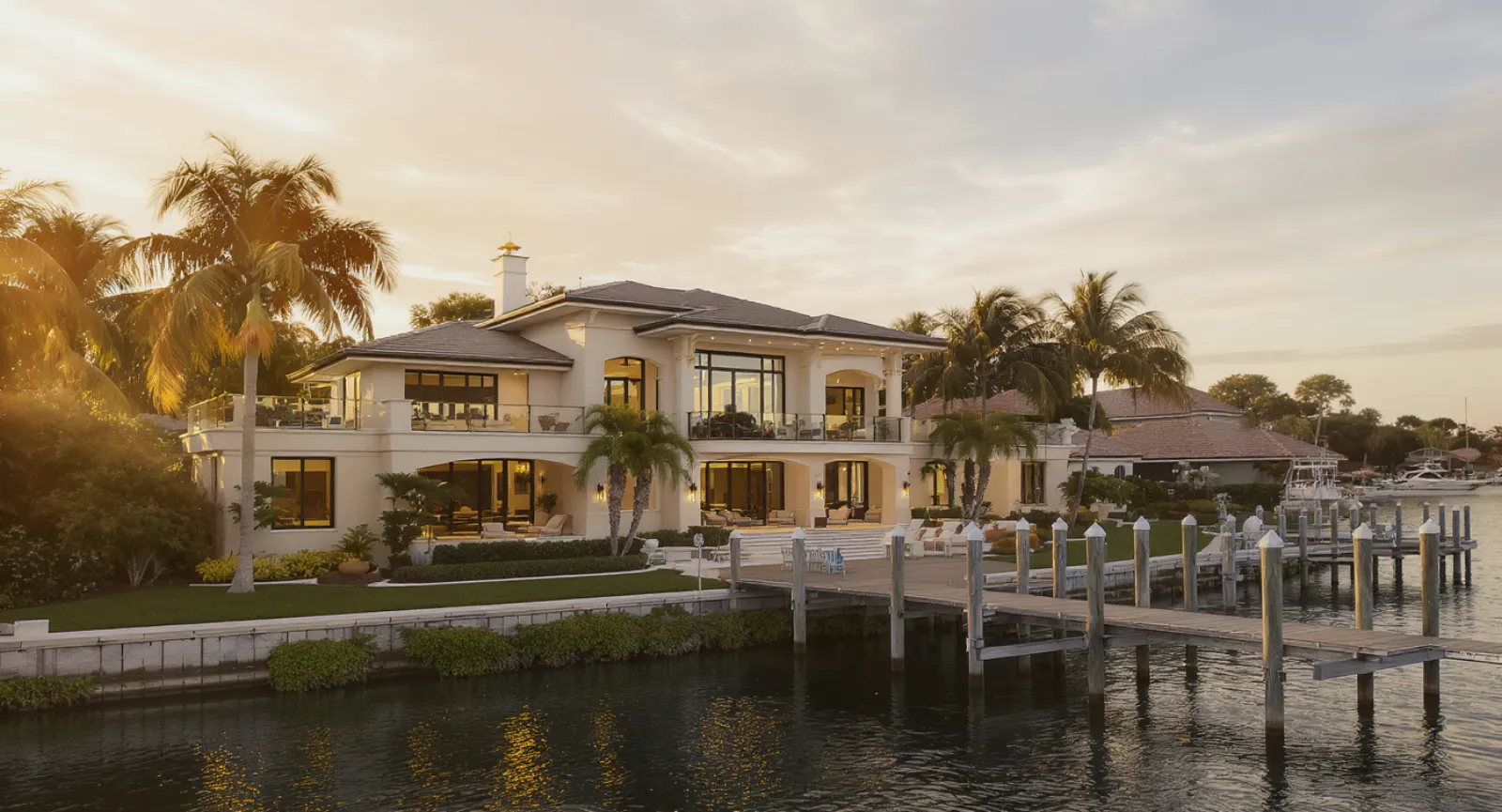
Service Areas
Building Across Greater Tampa Bay
From a Plant City base, Carapezza builds and restores homes across eight counties — coastal waterfront, suburban golf communities, and inland lakefront alike. One licensed builder for the whole bay.
Greater Tampa Bay isn't one place — it's a sprawl of distinct markets stitched together around the water. Davis Islands waterfront in Tampa, beach lots in Clearwater and Dunedin, golf-community estates in Pasco, lakefront homes in Lakeland, and the established neighborhoods of Plant City all sit within about thirty minutes of our shop. Since 1989, Carapezza has built and restored homes across all of it. That range matters here, because a home on a barrier island and a home on an inland lake are governed by very different rules — and we build to both.
The Region
Eight counties, one builder.
Tampa Bay is Florida's second-largest metro — roughly five million people spread across eight counties that wrap around the bay and stretch inland. We build and restore homes across all of them: Hillsborough (Tampa, Plant City, Valrico, Carrollwood, Hyde Park), Pinellas (St. Petersburg, Clearwater, Dunedin, Largo), Pasco (Wesley Chapel, Zephyrhills, Dade City), Polk (Lakeland, Winter Haven, Auburndale), Manatee (Bradenton, Anna Maria Island), Sarasota (Sarasota, Longboat Key, Siesta Key), Hernando (Spring Hill, Brooksville), and Citrus (Crystal River, Homosassa) on the northern fringe.
It's an enormous spread, and that's the point. Most custom builders work a single submarket — a beach town, a county, a cluster of subdivisions. Carapezza covers the whole bay from one Plant City headquarters, which puts the same crew, the same standards, and the same licensed building contractor on a Bayshore renovation, a Lakeland lakefront new build, and a Clearwater Beach elevation. You're not handing your project to whoever happens to work your ZIP code.
The Code Reality
Building for hurricanes and flood, the right way.
Tampa Bay sits on warm Gulf water, which is exactly what feeds hurricanes — and after Helene and Milton in 2024, nobody here needs convincing. Florida's building code is written for that reality, and a home built to it is a fundamentally different (and stronger) thing than a home built to mainland-average standards.
Wind & impact glazing
The Florida Building Code (8th Edition, effective Dec 31 2023, on ASCE 7-22 wind loads) sets design wind speeds across the bay. Within the wind-borne debris region near the coast, every glazed opening must be impact-resistant or shutter-protected and pass ASTM missile and cyclic testing.
Flood zones & elevation
FEMA flood maps put coastal lots in AE and VE (coastal high-hazard) zones. You can't build living space below the base flood elevation; you elevate to BFE plus your county's freeboard, and a PE- or PLS-signed Elevation Certificate documents it.
Termite & moisture
FBC §1816 requires soil pre-treatment and a vapor barrier under the slab before the pour — non-negotiable in this humid climate. We pair it with right-sized HVAC and dehumidification so a tight, modern envelope doesn't trap moisture.
Codes and flood maps change — we verify yours
Coastal vs. Inland
The same bay, two very different builds.
Here's where covering the whole region earns its keep. A waterfront lot on a Pinellas barrier island or in Sarasota's Siesta Key sits in a VE zone, where wave action and storm surge drive the design: deep pilings, elevated living space, breakaway lower walls, and often Miami-Dade-sealed (HVHZ-rated) windows specified as a premium upgrade even though Tampa Bay isn't formally a high-velocity hurricane zone. The cost and engineering live in the foundation and the envelope.
Move thirty minutes inland to Lakeland, Plant City, or Wesley Chapel and the rules shift. You're usually out of the surge zones, the wind loads ease, and the build logic changes — lakefront and lot drainage, larger floor plans, golf-community and master-planned design standards, and budget that goes into finishes and square footage rather than into surviving the Gulf. Same code book, very different page. Knowing which approach your lot demands — before the first line is drawn — is the difference between a home that's right-sized and one that's over- or under-built.
- 01
Read the lot first
Before design, we pull your flood zone, wind exposure, and county requirements. A VE-zone beach lot and an inland lakefront lot start in completely different places.
- 02
Engineer to the zone
Coastal builds lead with foundation and envelope — pilings, elevation, impact protection. Inland builds lead with floor plan, drainage, and finishes. We size the engineering to what the site actually demands.
- 03
Permit through the right authority
Each county and city runs its own portal and timeline — Hillsborough, Plant City, Pinellas, City of Tampa. We know the path and the documents each one wants, so the package moves.
- 04
Build to one standard
Whatever the zone, the finish standard is the same custom-home standard. The location changes the engineering, never the quality of what you live in.
Where We Build
Explore our service areas.
Every market in the bay has its own character, its own code wrinkles, and its own way of building. Here's where we work most — each with a closer look at what building there really involves.
Tampa
The metro core — luxury infill from Hyde Park and Palma Ceia to waterfront Davis Islands and Culbreath Isles.
Building in Tampa→St. Petersburg
Waterfront Pinellas living, flood-zone lots, and post-storm restoration along the bay and beaches.
Building in St. Petersburg→Plant City
Our home turf — established neighborhoods, acreage, and custom builds in eastern Hillsborough.
Building in Plant City→Lakeland
Inland Polk County: lakefront lots, larger floor plans, and golf-community estates away from the surge zones.
Building in Lakeland→Clearwater
Beach and intracoastal building — VE-zone foundations, impact glazing, and coastal-grade construction.
Building in Clearwater→Valrico
Minutes from our Plant City shop — Bloomingdale and River Hills custom homes, acreage builds, and major renovations.
Building in Valrico→Brandon
Established east-county suburb — infill custom homes, teardown-rebuilds, and large additions on Brandon's best lots.
Building in Brandon→FishHawk & Lithia
Deed-restricted FishHawk Ranch and rural Lithia — custom infill, acreage estates, and high-end renovations.
Building in FishHawk & Lithia→Why It Matters
Why one builder across the whole bay.
Tampa Bay has been one of the fastest-growing metros in the country — tens of thousands of new residents a year, with hundreds of thousands more projected through 2030. That growth has pulled in plenty of builders chasing the boom. A lot of them are new, narrow, or here for the cycle. We've built through more than three decades of boom-and-bust in this exact market, which is its own kind of credential: we know which subcontractors hold up, which county offices move fast and which move slow, and how to price a job that actually gets built for the number we quoted.
Covering all eight counties from one shop also means your project doesn't get handed off. The owner, Jimmy Carapezza, runs a family-owned company — not a franchise with regional managers who've never met. Whether you're building a multi-million-dollar waterfront home on Davis Islands or restoring a flood-damaged house in St. Petersburg, you get the same state-licensed Florida building contractor, the same crews, and the same standard of finish. One builder, one accountable name, across the whole bay.
Market figures shift — we price your specific project
The Track Record
Built on three and a half decades here.
Questions
Building Across Tampa Bay — FAQ
Do you really build across all eight Tampa Bay counties?+
Yes. From our Plant City headquarters we build and restore homes across Hillsborough, Pinellas, Pasco, Polk, Manatee, Sarasota, Hernando, and Citrus counties. Most of the bay's prime markets sit within about thirty minutes of our shop, and we've worked the region since 1989, so we know the county offices, the subcontractors, and the local conditions across all of it.
Do I need HVHZ (Miami-Dade) impact windows in Tampa Bay?+
Not strictly — Tampa Bay isn't a formal high-velocity hurricane zone the way Miami-Dade and Broward are. But within the coastal wind-borne debris region, the Florida Building Code does require impact-resistant or shutter-protected glazing on all openings. On coastal and near-coastal homes, many owners spec Miami-Dade-sealed (HVHZ-rated) windows as a premium upgrade for peace of mind. We'll walk you through the cost-versus-benefit for your specific lot rather than over- or under-spec it.
How does building in a FEMA flood zone change my project?+
If your lot is in a FEMA Special Flood Hazard Area (an AE or VE zone), you can't put living space below the base flood elevation. That usually means an elevated foundation — pilings or stem walls in coastal VE zones — plus a PE- or PLS-signed Elevation Certificate documenting the finished height for your county and insurer. It adds engineering and cost, but it's also what keeps the home insurable and standing. We confirm your exact zone and BFE before design, because flood maps get redrawn.
How do coastal and inland builds differ in cost and approach?+
Coastal waterfront lots put the money and engineering into the foundation and envelope — deep pilings, elevation, breakaway construction, and impact glazing to handle surge and wind. Inland lots in Lakeland, Plant City, or Wesley Chapel are typically out of the surge zones, so the same budget goes further into square footage, finishes, and lot work like drainage. The code book is the same; the page you're on is very different. We tell you which your lot demands before the first design line.
Why use one builder for the whole region instead of a local one?+
Because Tampa Bay isn't one market — it's a dozen. A builder who only works one beach town doesn't know how Polk County permits a lakefront home, and a Lakeland builder may never have engineered a VE-zone piling foundation. Covering all eight counties from one shop means the same licensed building contractor, crews, and standards on your project wherever it sits, with real experience in coastal, suburban, and inland building rather than one narrow specialty.
How long does residential permitting take around the bay?+
It varies by authority. Unincorporated Hillsborough and Pinellas County residential permits often run roughly two weeks once the package is complete, and cities like Tampa, St. Petersburg, Clearwater, and Plant City each run their own portals and timelines. Timelines shift with workload and the season, so we don't promise a fixed number — we assemble a complete, correct package for the right authority so it doesn't bounce back, and we verify the current turnaround before we commit you to a schedule.
Is termite pre-treatment really necessary?+
It's not optional — Florida Building Code §1816 mandates soil pre-treatment and a vapor barrier under the slab before the concrete is poured. In a climate this humid, it's also just good building. We pair it with right-sized HVAC and dehumidification so a modern, tightly-sealed home manages moisture instead of trapping it. It's a standard part of how we build, not an add-on.
Can you build a true luxury custom home in Plant City or inland, not just on the coast?+
Absolutely. Plant City is our home base, and we build high-end custom homes on acreage and in established neighborhoods there and across inland Polk and Pasco. Luxury in Tampa Bay isn't only waterfront — inland lots often deliver more square footage, privacy, and land for the budget, with golf-community and lakefront settings that rival the coast. We've built across the full spread, from premium to ultra-luxury, for more than thirty years.
Carapezza Custom Homes
Building anywhere in the bay?
Tell us your lot and your vision. We’ll tell you straight what it takes to build it well in your county — code, flood zone, permitting, and all.