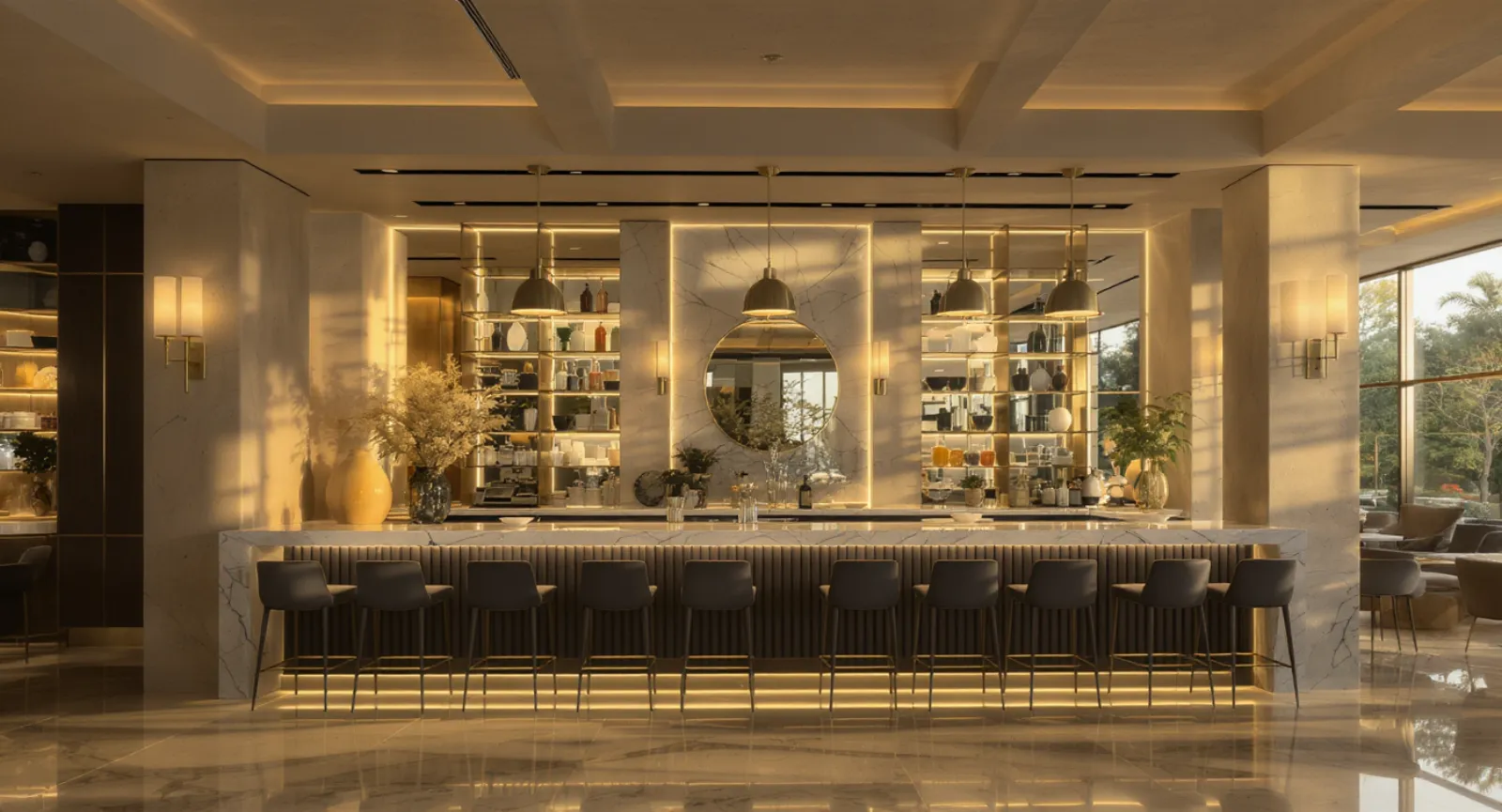
Commercial Buildouts · Tenant Improvements
Retail Buildouts
A store has one job before a customer ever buys anything: pull them in and move them through. We build retail spaces that do exactly that — on a schedule built around your opening date.
A retail buildout isn't just construction — it's the physical version of your brand, and it has a deadline attached to it the day you sign the lease. From the storefront and glazing a customer sees from the sidewalk to the checkout where the sale closes, every decision either helps the store sell or quietly gets in the way. As a licensed Florida general contractor working across Greater Tampa Bay, Carapezza builds retail spaces that look like the brand, move customers the way the merchandising plan intends, clear ADA and code, and open on time. This is one of three commercial buildout specialties we run, alongside restaurant buildouts and office buildouts.
What's Actually Involved
A retail buildout is a brand, a code package, and a deadline — at once.
Most retail spaces start as a “white box” or a vanilla shell — bare demised walls, a concrete slab, a capped-off plumbing stub, and a panel waiting for circuits. What turns that empty box into a store is a long list of coordinated trades: the storefront and entry, the floor and ceiling, lighting that makes product look right, fixtures and millwork, fitting rooms or a stockroom, a point-of-sale counter, signage, and the mechanical and electrical work hiding behind all of it. None of it is glamorous on its own. Together it's the difference between a space people walk past and a space people walk into.
The part that catches first-time and even seasoned retail operators off guard is how much of the timeline lives outside the actual construction. Landlord approvals, permitting, sign-criteria sign-off, long-lead fixtures, and utility coordination all run on their own clocks — and your lease-commencement date doesn't wait for any of them. Our job is to run those tracks in parallel from day one, so the work that can't start until a permit lands or a fixture ships isn't the thing that blows your opening.
Storefront & Customer Flow
The store should sell before anyone says hello.
Retail design is applied psychology. Where the entry sits, what a customer sees first, how the aisles guide them, and where the register lands all change how a store performs. We build to the merchandising plan, not around it.
Storefront, glazing & entry
The window line and entry are your first salesperson. We build storefront systems, display windows, and entries that read clearly from the sidewalk or the mall concourse — and meet the landlord's storefront criteria and Florida's wind-load requirements.
Merchandising-driven layout
Aisle widths, sightlines, a decompression zone at the entry, and a clear path to the back. We frame and finish the space around your fixture plan so the layout moves customers the way your merchandising team intends.
Lighting that sells
Ambient, accent, and display lighting tuned so product looks the way it should — apparel, jewelry, grocery, and electronics all light differently. Lighting is one of the highest-leverage decisions in a store, and we treat it that way.
Checkout & point of sale
The register counter is where the sale closes and where queues form. We build POS counters, cash-wrap millwork, and power and data drops positioned for the flow you want — including an ADA-accessible checkout lane.
Fitting rooms & fixtures
Fitting rooms, stockroom shelving, slatwall, gondolas, and custom display millwork — built and installed so the sales floor is ready to stock the day we hand it over, not weeks after.
Brand-consistent finishes
Flooring, wall finishes, ceiling treatments, and fixture details that match your brand standard — so a customer who knows your stores recognizes this one instantly.
Single Store or Multi-Location Rollout
One store, or the same store ten times over.
For an independent retailer, a buildout is a one-time event and the goal is simple: a space that looks like the brand you've built and opens without drama. For a regional or national chain, the goal shifts to consistency and repeatability — a finish package, a fixture standard, and a customer experience that has to land the same way in a Tampa power center as it does in a St. Petersburg mall. We build to a brand standard or prototype package, flag where a specific landlord or local code forces a deviation, and document what we did so the next store in the rollout starts from a known baseline instead of from scratch.
That documentation matters more than it sounds. The second store in a rollout should be cheaper and faster than the first, and it only gets there if someone is keeping track of what worked, what the landlord pushed back on, and which long-lead items to order earlier next time. As a builder, that record-keeping is part of what we hand you.
Code, ADA & Signage
The rules that decide whether you open.
A retail buildout lives or dies on accessibility, permitting, and sign approvals. None of it is optional, and most of it has to be designed in from the start rather than fixed at inspection.
ADA, from the front door to the fitting room
Retail is a public accommodation, so accessibility runs through the whole space: accessible entries and door hardware, an accessible route through the sales floor with compliant aisle clearances, an accessible checkout lane at the register, accessible fitting rooms, and ADA-compliant restrooms where your space includes them. Getting this right on paper before construction is far cheaper than discovering a too-narrow aisle or a non-compliant counter height at final inspection — which is exactly the kind of thing that delays an opening.
Permitting, signage & landlord sign criteria
Most retail buildouts need a building permit, and depending on scope, separate electrical, plumbing, mechanical, and sign permits — issued by the city or county your space sits in. Signage usually carries a second layer of approval: the landlord's written sign criteria, which dictate size, placement, illumination, and sometimes the exact sign type allowed in that center or mall. A sign can be fully permittable by the municipality and still be rejected by the landlord's criteria — so both approvals have to line up before fabrication starts. Specific permit requirements, fees, review timelines, and sign rules vary by jurisdiction and by landlord, so we confirm the current requirements for your exact address and your lease before we commit to a schedule.
The Date That Drives Everything
We build the schedule backward from your opening.
Retail has the hardest deadlines in commercial construction. A lease-commencement date starts the rent clock whether the store is open or not, and a grand-opening date is often tied to marketing, hiring, seasonal demand, or a mall's leasing calendar. Miss it and you're paying rent on a dark store — or worse, opening into a season that has already passed. So we plan in reverse: we fix the opening date first, then work backward through finishes, fixtures, inspections, permitting, and landlord approvals to find the real start date and the items that have to be ordered early.
Your opening date is a constraint, not a hope
How We Run It
From white box to grand opening.
- 01
Walk the space & set the date
We tour your white box, review the lease and landlord work letter to confirm what they deliver versus what's on you, and lock the opening date the whole schedule will be built around.
- 02
Design coordination & pricing
We coordinate the architect's and designer's drawings against your fixture and merchandising plan, flag code and ADA issues early, and give you a real, scoped budget rather than a placeholder.
- 03
Permitting & landlord approvals
We assemble the building, trade, and sign permit packages with the city or county, and run the landlord's plan review and sign-criteria approval in parallel so neither becomes the bottleneck.
- 04
Long-lead orders & demolition
Fixtures, storefront, signage, and any long-lead equipment are ordered first. Demolition and any landlord-required protection or barricades go up so trades can start clean.
- 05
Buildout & trades
Framing, MEP rough-in, storefront, ceilings, flooring, fixtures, millwork, lighting, and the POS counter — sequenced so inspections land on time and the sales floor comes together in the right order.
- 06
Inspections & punch
We carry the project through trade and final inspections, work the punch list, and resolve anything between substantial completion and a clean certificate of occupancy.
- 07
Turnover for stocking
We hand over a clean, inspected, signed-off space ready for your team to stock fixtures and merchandise — with enough runway before the date to set the store the way you want it.
- 08
Grand opening
The store opens on schedule. For a multi-location rollout, we capture what worked and what to order earlier so the next store starts ahead of where this one did.
Where your space sits changes how this runs. A strip-center or power-center space usually means coordinating with a single landlord and a property manager, with storefront and sign criteria to match the center. A mall space adds a tenant-coordination process, stricter barricade and after-hours work rules, and tighter storefront criteria along the concourse. A standalone or padbuilding gives you more freedom but puts site work, utilities, and the full sign permit squarely on you. We've built across all three around Tampa Bay and plan for the specific coordination each one demands.
Why a custom builder for a retail buildout
Retail work rewards a builder who sweats finishes and hits dates — and that's exactly the discipline a custom-home company brings. The same eye that makes a custom home's millwork, lighting, and finishes feel right is what makes a store feel like the brand instead of a generic box. As a state-licensed Florida building contractor serving Greater Tampa Bay since 1989, Carapezza manages the whole buildout — landlord coordination, permitting, sign approvals, every trade, and a finish standard you can put your name on — and runs it all against the one number that matters most: your opening date. When you're ready, we'll walk the space and build the plan backward from there.
Questions
Retail Buildouts — FAQ
How long does a retail buildout take in Tampa Bay?+
It depends heavily on the size of the space, the condition you're starting from, the scope of finishes and fixtures, and how fast permitting and landlord approvals move. A small, straightforward space in a vanilla shell moves much faster than a large store with extensive millwork and a full sign program. Rather than quote a flat duration, we build the schedule backward from your opening date and give you a staged timeline for your specific store.
What does a retail buildout cost?+
Cost is driven by square footage, the finish and fixture package, MEP and lighting scope, storefront and signage, and the condition of the space you're handed. A brand-standard rollout package costs differently than a one-off independent store. We don't publish a flat price because it wouldn't hold up — we scope your actual space, lease conditions, and brand standard and give you a real number.
What's the difference between a white box and a vanilla shell?+
Both describe an unfinished space a landlord delivers, but the line varies by lease. A white box is typically bare — demised walls, slab, a capped utility stub, and a base electrical service. A vanilla shell usually includes more: finished demising walls, a basic ceiling and lighting, an HVAC unit, a restroom, and a storefront. The first thing we do is read your work letter so everyone's clear on exactly what you're starting with and what's on you to build.
Do you handle landlord coordination and sign-criteria approval?+
Yes. Landlord coordination is central to retail work. We work within the landlord's design and storefront criteria, run their plan-review and tenant-coordination process, and route signage through their written sign criteria — which governs size, placement, illumination, and sometimes the exact sign type allowed. A sign can be permittable by the municipality and still rejected by the landlord, so we line up both approvals before anything is fabricated.
Will the buildout be ADA compliant?+
Yes — retail is a public accommodation, so accessibility is built in from the design phase. That covers accessible entries and door hardware, a compliant route through the sales floor, an accessible checkout lane, accessible fitting rooms, and ADA-compliant restrooms where your space includes them. We design these in up front because fixing an accessibility issue at final inspection is one of the most common causes of a delayed opening.
Can you build the same store across multiple locations?+
Yes. We build to a brand standard or prototype package and keep the customer experience and finishes consistent from one location to the next, flagging where a specific landlord or local code forces a deviation. We also document each store so the next one in the rollout starts from a known baseline and gets faster and more predictable instead of starting from scratch.
Will my store be ready in time for my lease-commencement or grand-opening date?+
That's the entire point of how we plan. We fix the opening date first and work backward through finishes, inspections, permitting, and landlord approvals to find the real start date and the long-lead items that have to be ordered early. We can't control how fast a municipality reviews a permit or how quickly a landlord turns around approvals — and those vary by jurisdiction and lease — but we manage the critical path aggressively and tell you straight where the risk is.
Do you build in malls, strip centers, and standalone buildings?+
All three, across Greater Tampa Bay. A strip or power center usually means one landlord and storefront criteria to match. A mall adds tenant coordination, barricade and after-hours rules, and tighter concourse storefront criteria. A standalone or pad building gives more freedom but puts site work, utilities, and the full sign permit on you. We plan for the specific coordination each setting requires.
Do you handle the MEP and lighting, or just the finishes?+
We handle the full buildout, including the mechanical, electrical, and plumbing work and the lighting design and installation. Lighting in particular is one of the highest-leverage decisions in a store — apparel, jewelry, grocery, and electronics all light differently — so we treat it as a sales tool, not an afterthought, and coordinate it with the rest of the trades.
Carapezza Custom Homes
Have a lease signed and an opening date looming?
The sooner we walk the space, the more schedule we can protect. Let's look at your white-box conditions, your sign criteria, and your grand-opening date — and build a plan backward from it.