Storm Damage Restoration · Rebuild to Code
Substantial Damage Reconstruction
When the damage crosses the 50% line, the home can't just be patched back the way it was — it has to be rebuilt to current code. Here's what that means, and how a licensed builder gets you there.
Hurricanes Helene and Milton put water into thousands of Tampa Bay homes in 2024, and many of those homes are now in a situation most owners have never heard of: the damage is severe enough that federal flood rules no longer allow a simple repair. Once a building is declared “substantially damaged,” fixing it back the way it was can be against code — it has to be brought up to today's flood standards instead. As a licensed Florida general contractor, Carapezza handles that rebuild end to end: the engineering, the permits, the county floodplain coordination, and the construction itself, built to the standard you'd expect from a custom-home company.
Start Here
What 'substantial damage' actually means.
“Substantial damage” is a specific federal term, not a description of how bad the house looks. It means the cost to repair the structure back to its before-damage condition equals or exceeds a set share of the building's market value. When a home crosses that line, it can't legally be returned to exactly what it was — it has to be brought into compliance with the flood code that applies today. For most flood-zone homes in Tampa Bay, that means the lowest floor has to sit at or above the base flood elevation.
This catches people off guard because the damage that triggers it isn't always dramatic. A few feet of storm surge through the first floor — drywall, insulation, flooring, cabinets, mechanical systems, and wiring — can add up fast against an older home's structure value. The point isn't how the home feels to walk through. It's the math, and the math is what the county uses to make its call.
The Legal Driver
The FEMA 50% rule and the county determination.
The rule most people know as the “50% rule” works like this: if your home is in a FEMA flood zone and the cost to repair it reaches 50% or more of the structure's market value— the building only, not the land — it's considered substantially damaged and must be brought up to current flood code. Just as important, that repair cost is counted cumulatively over a 12-month window in many communities, so a series of smaller projects can quietly add up to the threshold without any single one crossing it.
You don't make this determination yourself, and neither do we. Your local building or floodplain office issues the official substantial-damage determination, using its own valuation of the structure and an estimate of the repair cost. After Helene and Milton, Tampa Bay counties issued thousands of these letters. If you've received one, it sets the rules for what you're allowed to build — and it usually comes with a deadline. If you haven't, and your home took serious water, it's worth finding out where you stand before you start spending on repairs that may not be permitted.
This is time-sensitive — and county-specific
Repair vs. Rebuild
Why a like-for-like fix can be the wrong move.
Once a home is substantially damaged, the question isn't 'how do we put it back' — it's 'how do we make it compliant.' Those are two very different projects, and confusing them is where homeowners get hurt.
Like-for-like repair
Putting the home back exactly as it was. Below the 50% threshold this is often fine. Above it, on a flood-zone lot, it can be against code — and a permit office may stop the work or require it to be redone compliant.
Rebuild to current code
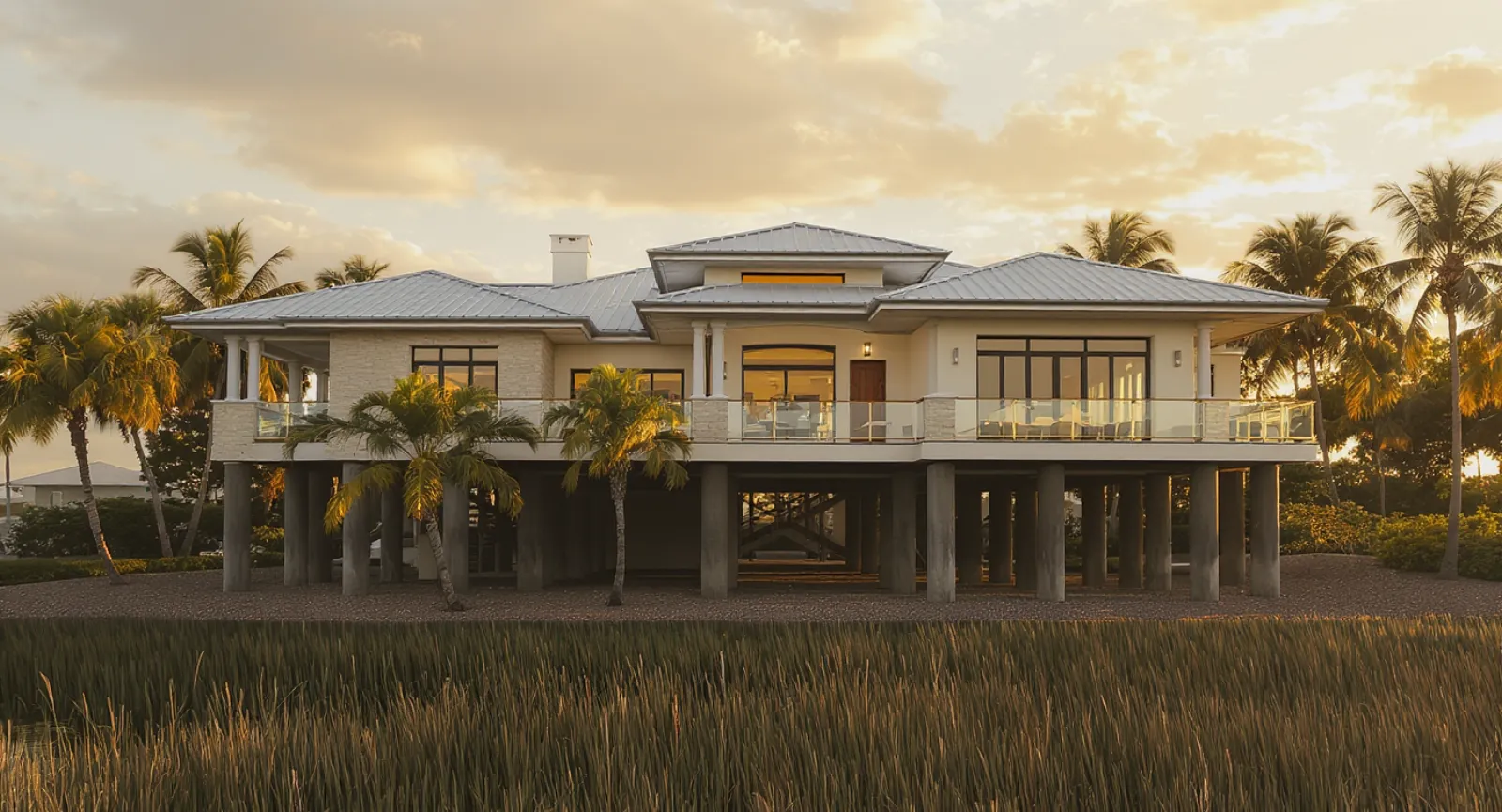
Reconstructing the home to meet today's flood standards — typically with the lowest floor at or above the base flood elevation plus your county's freeboard. It's more work up front, but it's the path that's actually allowed.
When reconstruction wins
When a home is already gutted past 50%, rebuilding it code-compliant from the ground up often costs less and delivers a better, safer, more insurable home than forcing an aging structure to comply piecemeal.
The hard truth is that on a substantially-damaged home in a flood zone, the cheapest-looking option — quietly repairing it back to normal — can be the one that lands you in real trouble: red-tagged work, denied insurance claims, and a home that can't be legally occupied or sold. Coming into compliance almost always means addressing the elevation of the lowest floor, which is why substantial damage and home elevation are so tightly linked. We won't re-explain the mechanics of a lift here — that page covers how a home is raised, what it costs to consider, and the Elevate Florida funding that can offset it. What matters at this stage is recognizing that “rebuild compliant” and “elevate” are usually the same decision.
Paying For It
Insurance, ICC, and the documentation that unlocks it.
A substantial-damage determination isn't only a constraint — it can also open funding. If you carry federal flood insurance (NFIP), your policy likely includes Increased Cost of Compliance (ICC) coverage: money specifically meant to help bring a substantially-damaged home up to code, including elevation or demolition-and-rebuild. ICC is supplemental. It stacks with your regular flood claim, with Elevate Florida, and with your own funds rather than covering everything on its own.
What unlocks all of it is documentation, and that's where having a builder in your corner early pays off. The county's determination letter, a properly scoped repair estimate, the permit package, the engineer's drawings, and ultimately the elevation certificate all have to line up. We coordinate the contractor's side of that paper trail so your claim and your program applications are working from the same set of facts — not three different numbers that trigger questions and delays. If the flooding also left you facing mold or saturated structure, our water damage restoration work folds into the same plan.
General information, not legal or insurance advice
How We Work It
From the determination letter to a finished, compliant home.
- 01
Read the letter & confirm the facts
We review your substantial-damage determination, confirm the deadline, the required elevation, and the cumulative-cost math with your county floodplain office, so the plan is built on what's actually required — not a guess.
- 02
Assess repair vs. rebuild
A licensed engineer and our team evaluate whether the home is a candidate to repair-and-elevate or a better candidate to reconstruct from the ground up, and we give you the honest cost comparison.
- 03
Design to current code
We design the compliant rebuild — foundation, elevation, and structure — to meet today's flood standards plus your county's freeboard, with engineered drawings the permit office will accept.
- 04
Permitting & program intake
We assemble the permit package and help line up the NFIP/ICC claim and any program funding, making sure every document tells the same story so the money isn't held up by mismatched numbers.
- 05
Reconstruction
We rebuild the home to the approved, code-compliant design — managing the trades, the schedule, and the inspections through to a finished home.
- 06
Certify & close out
An elevation certificate documents the finished height for your county and your insurer, and we close out the permits and the claim and program files.
The early steps matter most. Most of the expensive mistakes we see happen in the first few weeks — owners start tearing out and rebuilding before anyone has confirmed the determination, the deadline, or the elevation requirement. Slowing down long enough to get the facts straight, then moving deliberately, is almost always cheaper and faster than rushing in and redoing work that the permit office won't accept.
Why a builder, not just a restoration crew
A substantial-damage rebuild sits in an awkward middle ground. It's more than cleanup and drywall, and it carries code, permitting, and elevation requirements that a typical water-mitigation crew isn't set up to handle. As a licensed Florida general contractor that builds custom homes, Carapezza brings the whole picture: we read the determination with you, manage the engineer, pull the permits, coordinate the floodplain office, and reconstruct the home to a standard you'd expect from a custom-home company — not a patch-and-pray fix that fails its next inspection. We serve flood-prone coastal communities across Greater Tampa Bay, including St. Petersburg and Clearwater, and we work within the storm damage restoration process from the first letter to the final certificate.
Questions
Substantial Damage Reconstruction — FAQ
What does 'substantial damage' mean for my home?+
It's a specific federal flood term: it means the cost to repair your home to its before-damage condition equals or exceeds 50% of the structure's market value (the building, not the land). Once a home is declared substantially damaged, it generally can't be repaired back exactly as it was — it has to be brought up to current flood code, which on most flood-zone lots means the lowest floor must sit at or above the base flood elevation. Your county building or floodplain office makes the official determination.
Who decides whether my home is substantially damaged?+
Your local building or floodplain office, not you and not your contractor. They use their own valuation of the structure and an estimate of the repair cost to issue an official substantial-damage determination. We help you understand the letter and confirm the details, but the determination itself comes from the county.
Can't I just repair my home the way it was?+
If your repair cost is below the 50% threshold, often yes. If your home is in a flood zone and crosses that threshold, a like-for-like repair can be against code — a permit office may stop the work or require it to be redone compliant, and a non-compliant repair can put your insurance and your ability to occupy or sell the home at risk. That's exactly why it's worth confirming where you stand before you start.
How is the 50% threshold actually calculated?+
It compares the estimated cost to repair the structure against the structure's market value — the building only, not the land. Many communities also count repair costs cumulatively over a 12-month window, so several smaller projects can add up to the threshold. The exact valuation method and window are set by your community and can change, so we confirm how yours is calculated rather than assuming.
Is there a deadline to comply?+
Usually, yes. Counties set compliance deadlines for substantially-damaged homes, and those dates can be firm. Because the deadline and the rules behind it vary by community and change over time, we verify the current deadline for your specific address with your county floodplain office so you're not caught off guard.
Should I repair and elevate, or demolish and rebuild?+
It depends on how damaged the home already is, your flood zone, and the 50% math. When a home is gutted past the threshold, reconstructing it code-compliant from the ground up often costs less and delivers a better, more insurable home than forcing an aging structure to comply piece by piece. As a builder, we give you the honest comparison for your situation rather than steering you toward the bigger job.
How does this relate to home elevation?+
Closely. On a flood-zone lot, bringing a substantially-damaged home into compliance almost always means getting the lowest floor up to or above the base flood elevation — so 'rebuild compliant' and 'elevate' are usually the same decision. Our home elevation page covers how a lift works, what it costs to consider, and the Elevate Florida funding that can offset it.
Will insurance help pay for the code upgrades?+
If you carry NFIP flood insurance, your policy likely includes Increased Cost of Compliance (ICC) coverage, which helps pay to bring a substantially-damaged home up to code, including elevation or demolition-and-rebuild. It's supplemental — it stacks with your flood claim, with Elevate Florida, and with your own funds rather than covering everything. We coordinate the contractor's documentation these programs require so the funding actually lands.
Why use a general contractor instead of a restoration company?+
A substantial-damage rebuild involves code, permitting, engineering, and elevation requirements that a standard water-mitigation crew isn't set up to handle. As a state-licensed Florida building contractor that builds custom homes, we manage the engineer, the permits, the floodplain coordination, and the reconstruction itself — and build to a standard that passes inspection the first time.
Is this page legal or insurance advice?+
No. This is general information to help you understand your situation. Floodplain rules, valuation methods, ICC limits, and program terms vary by community and change over time, so we confirm the current requirements with your county and official sources before you make decisions, and point you to the right legal, tax, and insurance professionals for those questions.
Carapezza Custom Homes
Got a substantial-damage letter?
The county compliance clock is real, and the wrong first move can cost you. Let's review your letter, your flood zone, and your options before a deadline forces the decision.