Storm Damage Restoration · Our Specialty
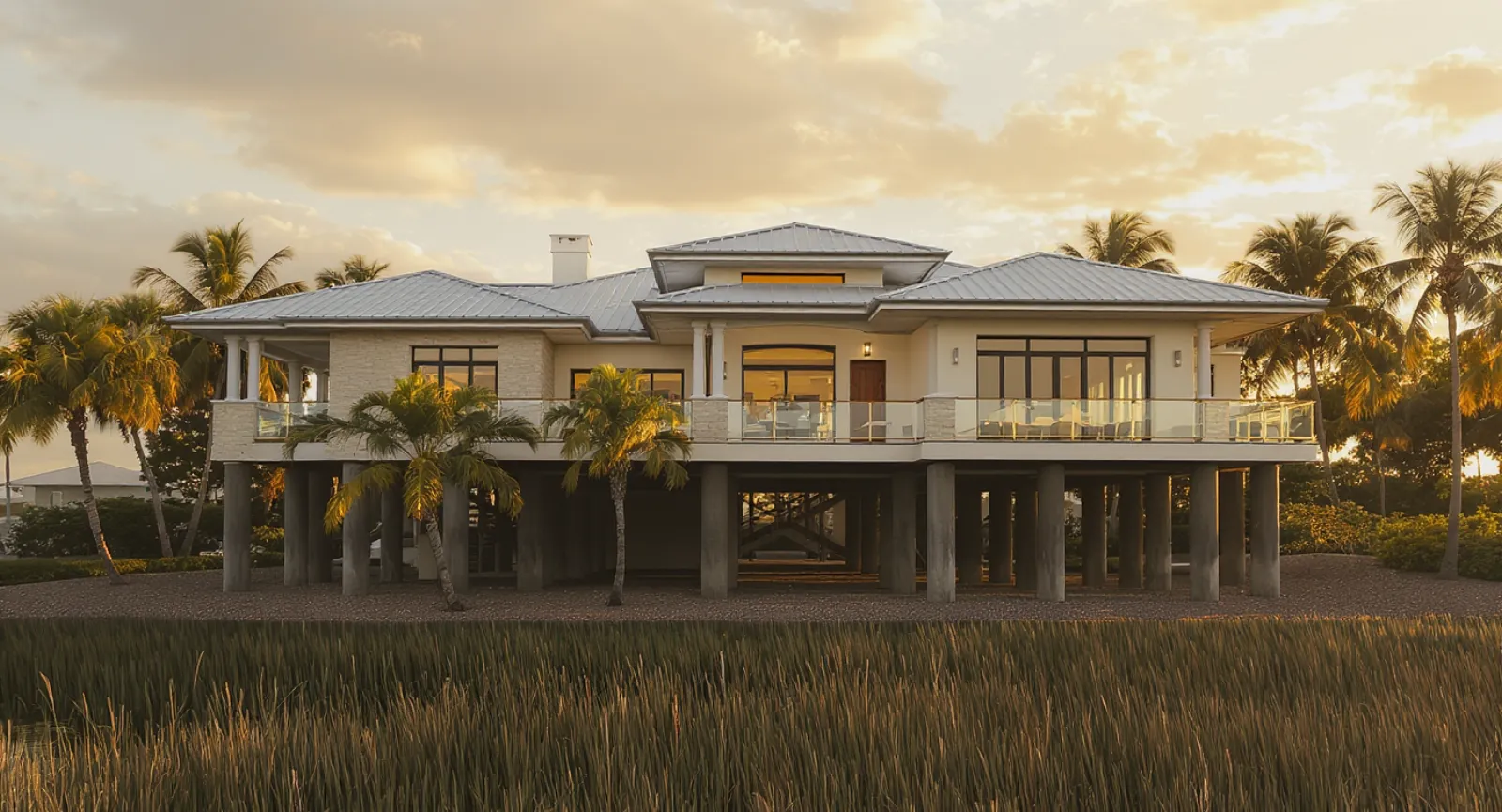
Home Elevation & the Elevate Florida Program
When a flood-damaged home has to come up to code, raising it above the water is often the smartest path — and there's funding to help. Here's how it works.
Hurricanes Helene and Milton pushed water into thousands of Tampa Bay homes in 2024. For many homeowners, the damage was severe enough to trigger the federal “substantial damage” rule — which means the home can't simply be repaired the way it was. It has to meet current flood code, and on a flood-zone lot that usually means lifting it above the base flood elevation. As a state-licensed Florida building contractor, Carapezza handles the engineering, permitting, the lift itself, and the rebuild — and helps you tap the funding designed for exactly this.
Why You Have To Elevate
The FEMA 50% rule, in plain English.
If your home sits in a FEMA flood zone and the cost to repair it reaches 50% or more of the structure's market value (the building, not the land), federal rules require the whole home to be brought into compliance with current flood code — typically meaning the lowest floor must sit at or above the base flood elevation, plus the freeboard your county requires. The cost is counted cumulatively over a 12-month window, so several smaller projects can add up to the threshold.
After Helene and Milton, counties issued thousands of “substantial damage” determinations doing exactly this. It's the single most important thing to understand before you start repairs: a like-for-like fix may not be legal, and finding that out halfway through is expensive.
This is time-sensitive — and county-specific
The Funding
What the Elevate Florida program covers.
Elevate Florida is a statewide residential mitigation program run by the Florida Division of Emergency Management, funded largely through FEMA. For qualifying homes, it can cover the majority of the cost to elevate — or to demolish and rebuild elevated.
Structure elevation
Lifting your existing home onto a new, taller foundation so the living space sits above the flood.
Mitigation reconstruction
When a home is too damaged to lift, demolishing and rebuilding it code-compliant and elevated — often the better value once a home is past 50%.
Cost-share assistance
For qualifying properties the program covers a large share of eligible costs, with a higher share for repetitive-loss homes. Exact splits and caps are set by the program and change over time.
Program details change — we verify yours
How a Lift Works
What actually happens when we raise a home.
- 01
Assessment & engineering
We confirm your flood zone, the required elevation, and whether your home is a candidate to lift or a better candidate to rebuild elevated. A licensed engineer designs the new foundation.
- 02
Permitting & program intake
We assemble the permit package with your local floodplain office and help line up the Elevate Florida and insurance paperwork that funds the work.
- 03
Utility disconnect
Water, sewer, electric, and HVAC are safely disconnected and prepared to be raised and reconnected at the new elevation.
- 04
The lift
The home is raised incrementally onto jacks — usually a day or two — while the new piling, pier, or stem-wall foundation is built beneath it.
- 05
Reconnect & finish
The home is set on its new foundation, utilities are reconnected above the flood line, and new access stairs, landings, and finishes are completed.
- 06
Certify & close out
An elevation certificate documents the finished height for your county and your insurer, and we close out the permits and the program file.
Most homeowners are surprised to learn they usually only need to be out of the home for a day or two during the actual lift — the longer part is the permitting, foundation work, utility reconnection, and finishing. Wood-frame homes and masonry/block homes are both routinely elevated, though block homes take more structural engineering. Once raised, the ground level becomes non-habitable space — parking or storage — because living space can't sit below the flood elevation.
Paying For It
Elevate Florida isn't the only source.
If you carry federal flood insurance (NFIP), your policy likely includes Increased Cost of Compliance (ICC)coverage — money specifically meant to help bring a substantially-damaged home up to code, including elevation. It's supplemental: it stacks with Elevate Florida and your own funds rather than covering everything. Many Tampa Bay communities also participate in FEMA's Community Rating System, which can lower flood-insurance premiums once your home is elevated and properly documented.
We help you understand how these pieces fit together for your situation — and we coordinate the contractor's side (the contract, permits, and elevation certificate) that these programs require.
Why a builder, not just a lifter
Elevating a home is part structural engineering, part heavy lifting, and part finished construction — new stairs, reconnected utilities, restored interiors, and a home that looks right when it's done. As a state-licensed Florida building contractor that builds custom homes, Carapezza brings the whole picture: we manage the engineer, pull the permits, coordinate the lift, and rebuild to a standard you'd expect from a custom-home company. And we help you navigate Elevate Florida from application to closeout, so the funding actually lands.
Questions
Home Elevation & Elevate Florida — FAQ
Does Elevate Florida pay to raise my house?+
For qualifying flood-prone and substantially-damaged homes, the program covers a large share of eligible elevation or rebuild costs, with the homeowner responsible for a portion (a smaller portion for repetitive-loss properties). The exact cost-share, caps, and application windows are set by the state and FEMA and change over time, so we confirm the current terms and your eligibility before you count on a number.
What is the FEMA 50% rule and does my home trigger it?+
If your home is in a flood zone and the cost to repair it reaches 50% or more of the structure's market value, it's considered 'substantially damaged' and must be brought up to current flood code — usually elevation to the base flood elevation plus your county's freeboard. The cost is counted cumulatively over a 12-month period. Your county floodplain office makes the official determination, and we help you understand where you stand.
How much does it cost to elevate a house in Florida?+
It varies widely with the size of the home, the foundation type, soil conditions, and how far it has to be raised — and program funding can offset much of it for qualifying homes. We don't publish a flat price because it wouldn't hold up; we assess your specific home and give you a real number alongside the funding you may qualify for.
Can a concrete block (masonry) home be elevated?+
Yes. Block and masonry homes are routinely elevated; they require more structural engineering than wood-frame homes because of their weight and rigidity, which can affect the cost and approach. In some cases — especially when a block home is heavily damaged — rebuilding it elevated is more cost-effective than lifting it.
What is ICC (Increased Cost of Compliance) coverage?+
If you carry NFIP flood insurance, ICC is coverage that helps pay to bring a substantially-damaged home into compliance, including elevation. It's supplemental funding that stacks with Elevate Florida and your own contribution rather than covering the full cost. We help you understand how it applies and coordinate the documentation it requires.
How long does home elevation take?+
The lift itself is usually a day or two, but the full project — engineering, permitting, foundation, utility reconnection, and finishing — runs longer, and program timelines add lead time on the funding side. We give you a realistic, staged schedule for your specific home.
Do I have to move out while my home is elevated?+
For most projects you only need to relocate for the day or two of the actual lift. Living through the surrounding foundation and finishing work is possible for some homeowners and disruptive for others — we'll be straight with you about what your project involves.
Should I elevate, or demolish and rebuild?+
It depends on the condition of the home, your flood zone, and the 50% math. When a home is already heavily damaged, 'mitigation reconstruction' — rebuilding it elevated from the ground up — can cost less and deliver a better home than lifting an aging structure. As a builder, we give you the honest comparison for your situation.
Will my flood insurance go down after I elevate?+
Often, yes. Once your home sits above the base flood elevation and you have an elevation certificate documenting it, your flood-insurance rating typically improves, and communities in FEMA's Community Rating System may see additional discounts. The exact change depends on your home and your policy.
Is the Elevate Florida application still open?+
Program windows open and close and the process moves in stages, so 'is it open right now' is exactly the kind of thing we verify against the official Florida Division of Emergency Management program before advising you. Reach out and we'll check the current status for your situation.
More Storm Damage Restoration
Carapezza Custom Homes
Facing a substantial-damage letter?
The clock on flood-code compliance is real. Let's review your home, your flood zone, and your funding options before a deadline forces the decision.