adu
ADU vs. In-Law Suite: What the Difference Actually Means in Florida
An ADU is a zoning classification. An in-law suite describes how a room is used. In Florida that difference decides kitchens, entrances, and whether you can rent.
An ADU is a zoning classification. An in-law suite is a description of how a family uses a room. That sounds like semantics right up until you file for a permit in Hillsborough County, because the code does not care what you call the space. It cares whether the space can function as an independent dwelling. Florida law defines an accessory dwelling unit as "an ancillary or secondary living unit, that has a separate kitchen, bathroom, and sleeping area," either inside the primary structure or elsewhere on the same lot (s. 163.31771, F.S.). Put all three in, and you have built an ADU whether you intended to or not. Leave one out, and what you have is a suite: rooms that are legally part of the house.
That distinction is what decides the questions homeowners actually ask us. Whether the space can have its own address. Whether it can be rented. Whether it needs its own entrance, its own meter, its own septic capacity. Whether the county reviews it as a room addition or as a second dwelling on the parcel.
The Three-Part Test
Sleeping, cooking, sanitation. Almost every Florida jurisdiction uses some version of that triad, and the City of Tampa states it plainly: an ADU functions as fully independent living quarters with a kitchen, a bathroom, and a sleeping area (City of Tampa, Accessory Dwelling Units).
An in-law suite that stops short of the third element stays a room addition. A bedroom, a full bath, a sitting area, a private exterior door, even a small refrigerator and a sink can all sit comfortably inside the definition of a primary residence. That is why so many multigenerational projects in Plant City and Brandon get built as home additions rather than as separate units. The family gets the privacy it wanted without triggering a second-dwelling review.
Interior access matters too. Hillsborough County's code is direct about this: a detached structure, or any portion of a dwelling that cannot be reached internally from within the house, may not be used for independent living quarters or for sleeping at any time unless it meets the accessory dwelling standards. Sealing off a suite with no interior door is not a workaround. It is the thing that makes the county call it a dwelling.
Attached, Detached, and the Garage Conversion
Three common forms, treated three different ways.
Attached is a wing or a second-floor space connected to the main house. If it keeps interior access and skips the kitchen, it typically remains part of the primary residence. Add the kitchen and it becomes an attached ADU, which is still an ADU.
Detached is a backyard cottage or guest house. This is unambiguously a second structure, and it draws the full set of zoning questions: minimum lot area, separation from the main house, height relative to the primary dwelling, and where it can sit on the lot. Unincorporated Hillsborough County limits accessory dwelling living space to 900 square feet, requires a minimum lot area of 7,000 square feet in most cases, and requires the principal dwelling to be owner-occupied (Hillsborough County LDC Sec. 6.11.02). Accessory dwellings there are a conditional use, permitted in some residential and agricultural districts and prohibited in others.
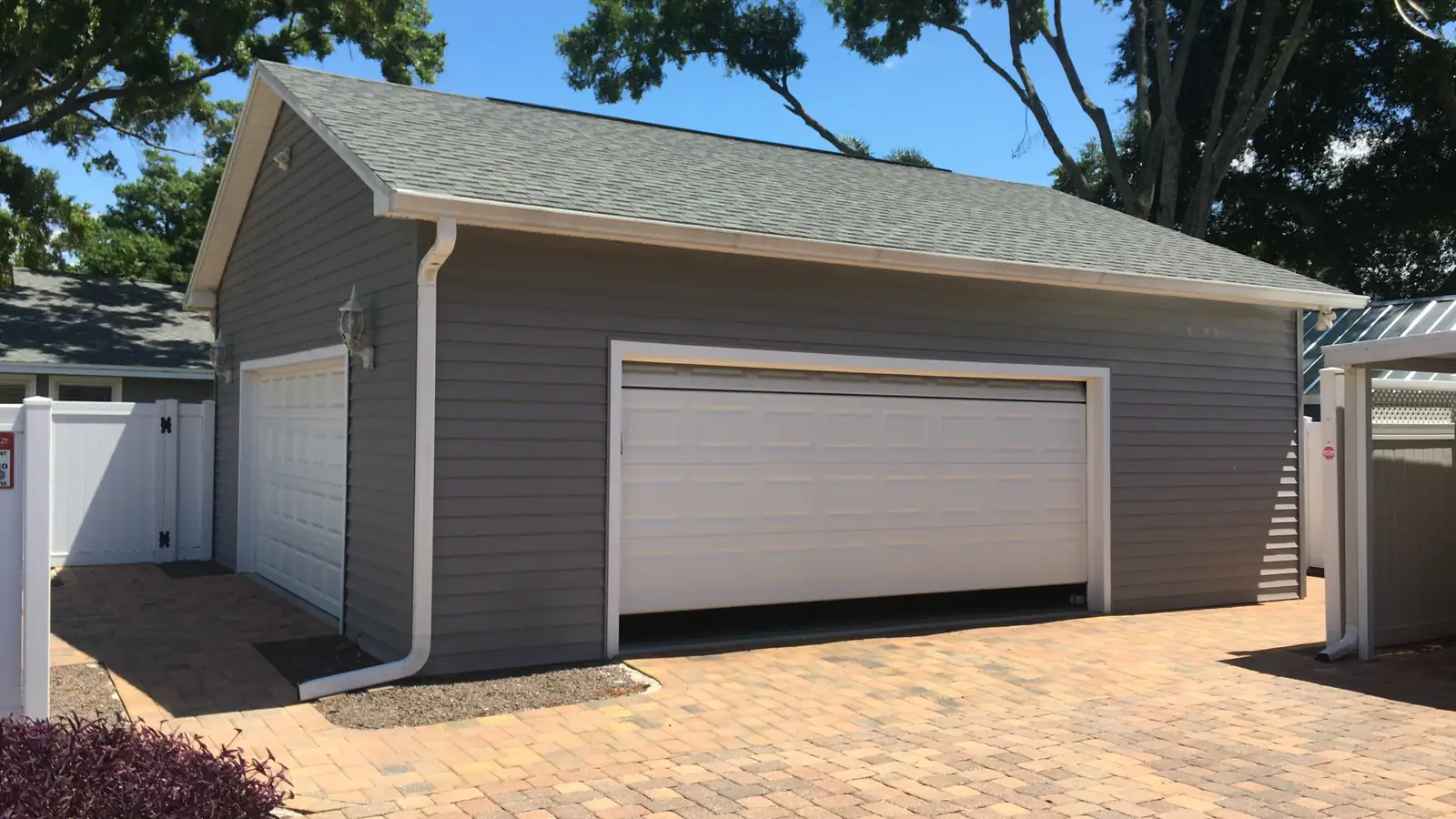
Garage conversions are the most common and the most misunderstood. Converting a detached garage into livable space almost always creates a detached ADU by definition, because there is no interior connection to the house. Converting an attached garage is more forgiving, though you are still changing a non-habitable space into habitable space, which brings in egress, ceiling height, insulation, and flood elevation requirements under the Florida Building Code.
The Second Kitchen Question
This is the single thing that flips a suite into a unit more often than anything else, and it is worth being deliberate about it during design rather than discovering it at plan review.
A wet bar with a sink, a beverage refrigerator, and cabinetry is generally not a kitchen. A range, a cooktop, or a permanently installed cooking appliance generally is. Some jurisdictions read the definition broadly enough that a microwave or hot plate counts as a cooking element. If your goal is a suite that stays legally part of the house, the design has to be drawn with that line in mind from the beginning, because relocating a gas line or a 240-volt circuit after framing is expensive and obvious.
Where Local Rules Stand Right Now
Florida ADU rules have moved recently, and some of what is published online is out of date.
City of Tampa. ADUs are a Special Use, allowed in a defined set of neighborhoods and overlay districts. Tampa amended its rules in July 2024, expanding the eligible areas from four to roughly ten (Seminole Heights, Tampa Heights, East Tampa and Lowry Park Central, plus additions including Sulphur Springs, Temple Crest, Wellswood and Riverside Heights) and relaxing the owner-occupancy rule so the owner may occupy either structure (City of Tampa, August 2026). Some city pages still describe the older requirement, so confirm current terms with Development & Growth Management. Outside the eligible areas, the city permits Extended Family Residences, which are the same physical thing restricted to occupancy by a family member. The city's ADU map viewer is the authoritative source for a specific address.
Unincorporated Hillsborough County. Governed by the accessory dwelling standards cited above. These do not apply inside Tampa, Plant City, or Temple Terrace, each of which runs its own zoning code. If your property is in Plant City limits, confirm the standards with Plant City's planning department directly, because the county rules are not the ones that will govern your permit.
Pinellas County. Unincorporated Pinellas raised its maximum ADU size from 750 to 1,000 square feet in July 2024, kept the 750-square-foot cap inside the Coastal Storm Area and other flood hazard areas, and waived owner-occupancy for units deed-restricted as affordable. The county also created a multigenerational tax exemption for ADUs housing a parent or grandparent age 62 or older (Pinellas County ADU update). St. Petersburg has its own separate code.
State law. Senate Bill 48 in the 2026 session would have required every local government to allow ADUs by right in single-family zones. It died in the House on March 13, 2026 (SB 48 bill history). The affordable housing bill that did pass, HB 1389 (Ch. 2026-179), does not touch ADU zoning. Its ADU provision is a tax one: a property appraiser may not deny an owner-occupant's homestead exemption solely because the property has an ADU that is rented or could be rented, and a rented ADU is assessed separately and taxed on its use. So there is no statewide preemption in effect. Anyone telling you Florida now requires cities to approve ADUs is describing a bill that did not become law.
Permitting, Utilities, and the Inland Lot Problem
A permitted ADU is reviewed as a dwelling unit, which changes the math in ways that surprise people. Impact fees are typically assessed per dwelling unit, so a second unit can carry its own school, transportation, and utility connection fees that a bedroom addition would not. Water and sewer connections may require separate taps or an upsized service.
On larger inland parcels around Plant City, Valrico, and Lithia, septic is the constraint that decides feasibility more often than zoning does. An onsite treatment and disposal system is sized to the number of bedrooms it serves. Adding a unit generally means the Florida Department of Health has to review capacity, and an undersized drainfield can mean a system replacement rather than a modification. That is a conversation to have during design, not after.
Resale, Appraisal, and Insurance
A legal, permitted ADU is an asset an appraiser can credit and a buyer can finance. An unpermitted conversion is a liability that surfaces during inspection and can stall a closing. Insurance carriers also treat a detached unit with a kitchen differently than a bedroom addition, and a rented unit differently again, so the policy conversation belongs early in the process rather than after the certificate of occupancy.
None of this is a reason to avoid the project. It is a reason to decide, on purpose and up front, which of the two things you are building. We work through that at the design table on our ADU and in-law suite projects, before drawings go to permit, because the answer shapes the floor plan rather than the other way around.
One caution worth stating plainly: nothing here tells you an ADU is legal on your particular lot. Zoning is parcel-specific, and district, lot size, overlay, deed restrictions, and HOA covenants can each independently rule it out. Verify with your jurisdiction before you commit to a design.
Thinking through a multigenerational addition or a backyard unit? Start a conversation with us and we will help you work out which path your lot and your local code actually support.
Questions
Frequently Asked Questions
What is the actual difference between an ADU and an in-law suite?+
An accessory dwelling unit is a zoning term for a secondary living unit with its own kitchen, bathroom, and sleeping area. An in-law suite is an informal description of a bedroom and bath used by a relative, and it usually stays legally part of the primary house. Florida's statute defines the ADU; nothing in the code defines an in-law suite. Which one you have depends on what the space contains, not what you call it.
Does adding a second kitchen turn my in-law suite into an ADU?+
Usually, yes. Full cooking facilities plus a bathroom plus a sleeping area is the test most Florida jurisdictions apply, and a second kitchen is the piece that flips a suite over the line. Some codes count a hot plate or microwave as a cooking element. If you want the space to stay part of the primary residence, plan a wet bar without a range and confirm the wording with your building department before drawing it.
Can I build an ADU anywhere in Hillsborough County?+
No. In unincorporated Hillsborough County, accessory dwellings are allowed only in certain agricultural, single-family, duplex, and multi-family zoning districts, and they are prohibited in others. The City of Tampa allows them only in designated neighborhoods and overlay districts, with everywhere else limited to Extended Family Residences. Zoning is parcel-specific, so the answer for your lot has to come from your jurisdiction.
Did Florida pass a law requiring cities to allow ADUs?+
Not as of August 2026. Senate Bill 48 in the 2026 session would have required local governments to allow ADUs by right in single-family zones, but it died in the House on March 13, 2026. A separate housing bill that did become law, HB 1389, reaches ADUs only through property tax treatment, protecting the homestead exemption where an ADU is rented. It is not a zoning mandate. Local zoning still controls whether you can build one.
Will an ADU affect my homeowners insurance or appraisal?+
Both, and you should raise it early. A detached accessory structure with plumbing and a kitchen is usually insured differently than a bedroom addition, and some carriers treat a rented unit as a change in occupancy. Appraisers can only give full credit to a permitted, legal unit; an unpermitted conversion often adds no appraised value and can complicate a sale or refinance.
Our Disciplines
More Guides
Get Started